
Table of contents
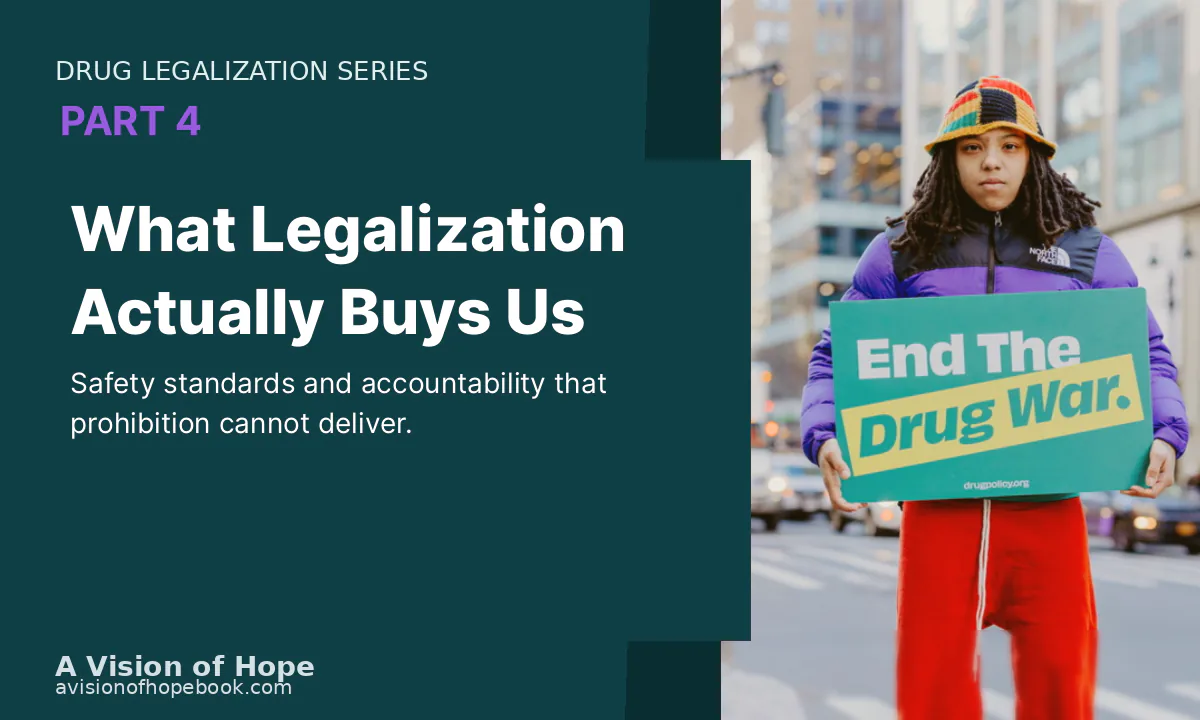
What Drug Legalization and Regulation Actually Buys Us
Safety standards and accountability that prohibition cannot deliver.
Most debates about drug policy get trapped in the same false choice.
Either we keep punishment as the default, even though it keeps failing, or we pretend the only alternative is “anything goes.”
That is not the real choice.
The real choice is whether we want drugs governed by a regulated drug supply and public health standards, or governed by black market incentives and violence. That is what drug legalization and regulation actually means in practice.
If you want the clean definitions of legalization vs decriminalization vs regulation, read Part 1.5.
Here is the plain-English version:
-
Decriminalization changes whether possession and use is treated as a crime.
-
Drug legalization creates a legal pathway to access.
-
Drug regulation is the safety and accountability system that decides whether legalization improves outcomes or just shifts the chaos.
This post is about what we actually buy when we choose drug policy reform built on regulation instead of prohibition.
Direct Answer
Drug legalization and regulation buy a tested, labeled supply that prohibition cannot deliver. In Colorado, marijuana arrests fell 68% from 2012 to 2019 and youth use did not change significantly, while poison control calls and marijuana DUIs rose. A study of Colorado and Washington found no lasting rise in violent or property crime. Old drug records still carry federal penalties.
Why does prohibition make drug use more dangerous?
The modern drug crisis is not only about “bad decisions.” It is also about unstable supply.
When drugs are illegal, the market rewards concealment, potency, and speed. That is how we end up with fentanyl showing up in places it was never supposed to be, including counterfeit pills. [1]
Fentanyl is so potent that tiny dosing errors can be fatal, which makes “guesswork drugs” a direct overdose prevention failure. [1]
DEA lab testing has warned that a large share of fentanyl-laced counterfeit pills contain a potentially lethal dose. That is not a moral argument. That is a supply argument. [2]
If we keep pretending the supply does not matter, we will keep losing people who never planned to die.
This is why I keep saying drug legalization is not endorsement. It is harm reduction and public safety.
What does drug legalization and regulation actually buy us?
A regulated drug supply is not vibes. It is infrastructure.
It buys us standards, controls, and consequences that do not exist in the black market.
Here is what drug legalization and regulation can buy in real-world terms:
- Testing for identity and potency
-
People should know what they are taking.
-
Sellers should be accountable for contamination and mislabeling.
- Labeling and dosing information
- Standardized dosing is how you reduce overdose prevention risk without pretending abstinence is the only path.
- Licensed distribution and real enforcement
-
Regulation means licensing, inspections, penalties, recalls, and accountability.
-
It also means unlicensed production stays illegal.
- Age limits, marketing limits, and point-of-sale controls
- The black market has no age gate. Drug regulation does.
- A system that can adapt when the risk changes
- The street supply evolves fast. A regulated system can update standards fast.
That is what a regulated drug supply buys us: predictability, accountability, and fewer funerals.
Harm reduction tools are what a regulated system looks like on the ground
A lot of people hear “harm reduction” and think it means approval.
It does not.
Harm reduction means you take reality seriously enough to keep people alive long enough to choose recovery and addiction treatment.
In a world where fentanyl and counterfeit pills exist, harm reduction is a public health necessity, not a political statement. [1]
Here are three practical examples that belong inside drug legalization and regulation conversations.
Fentanyl test strips are a basic safety tool
Fentanyl test strips give people information before they use. They are one of the simplest overdose prevention tools available, especially when the supply is contaminated or unpredictable. [3]
A regulated drug supply reduces the need for this kind of defensive behavior, but we are not in that world yet. Until we are, fentanyl test strips are a rational response to a contaminated market.
If you want to argue against fentanyl test strips, you are arguing for ignorance as policy. That is not public safety.
Syringe services programs reduce disease and connect people to care
Syringe services programs are one of the clearest examples of public health beating ideology.
They reduce the spread of infectious disease, provide safer supplies, and create a point of contact where people can be connected to services, including addiction treatment and recovery support. [4]
CDC summarizes evidence that syringe services programs are associated with large reductions in HIV and hepatitis C transmission and do not increase crime or drug use. [4]
That matters because drug policy reform is not just about overdoses. It is also about the long tail of preventable harm that follows people for years.
This is harm reduction that looks like public safety.
Supervised consumption sites reduce deaths and increase access to treatment
Supervised consumption sites are politically controversial because people confuse “supervision” with “permission.”
But the evidence base exists, and it is not subtle.
A systematic review in the American Journal of Preventive Medicine reports that supervised injection facilities are associated with reductions in overdose morbidity and mortality, improvements in safer use behaviors, improved access to addiction treatment, and no increase or reductions in crime and public nuisance in the surrounding area. [5]
Supervised consumption sites are not a “solution” by themselves. They are a pressure-release valve in a system where people are dying.
They are also a mirror.
If we refuse supervised consumption sites because we would rather people die out of sight, that is not morality. That is control.
Is legalization also a budget argument?
If you want a system that is sustainable, you have to invest upstream.
NIH highlights that treatment and prevention efforts can reduce overall costs, including substantial savings relative to downstream expenses. [6]
That is why drug policy reform should be measured by outcomes, not by arrests.
A public health approach is not “soft.” It is fiscally literate.
What should still be illegal under legalization with strict drug regulation?
Drug legalization and regulation does not mean “anything goes.” It means the rules become clearer and enforcement becomes more targeted.
What should still be illegal:
-
Unlicensed production and trafficking outside the regulated drug supply
-
Sales to minors
-
Fraud, mislabeling, and contamination
-
Impaired driving
-
Violence, coercion, and exploitation
-
Violations of safety standards, licensing rules, and inspections
That is public safety.
Punishing mere use as the default response is not.
What has drug legalization actually changed so far?
Colorado is the best place to look, because the state has been required by law to report on it since 2013. Its Division of Criminal Justice publishes the numbers every other year.[7] Figures below were checked November 2, 2026, against the source pages linked.
| Measure | What changed | Source (published) |
|---|---|---|
| Total marijuana arrests in Colorado, 2012 to 2019 | Down 68%, from 13,225 to 4,290 | Colorado DCJ, July 2021 |
| Marijuana-related court case filings, 2012 to 2019 | Down 55% | Colorado DCJ, July 2021 |
| Marijuana arrest rate, Black vs white residents, 2019 | 160 vs 76 per 100,000, still more than double | Colorado DCJ, July 2021 |
| Juvenile marijuana arrest rate, 2012 to 2019 | Down 42%, from 599 to 349 per 100,000 | Colorado DCJ, July 2021 |
| Past-30-day marijuana use, middle and high school students | 19.7% in 2013, 20.6% in 2019, no significant change | Colorado DCJ, July 2021 |
| Poison control calls mentioning marijuana | 41 in 2006, 276 in 2019 | Colorado DCJ, July 2021 |
| DUIs where marijuana was identified as an impairing substance (State Patrol) | 12% of DUIs in 2014, 31% in 2020 | Colorado DCJ, July 2021 |
| Treatment admissions with marijuana as the primary substance | 222 per 100,000 in 2012, 182 in 2019 | Colorado DCJ, July 2021 |
| Long-term violent and property crime rates after legalization, Colorado and Washington | No statistically significant long-term effect | Lu et al., Justice Quarterly 2021 (OJP abstract) |
Colorado’s own report warns that the data sources vary a lot over time, so it is hard to say how much of any change was caused by legalization.[7] More drug-recognition officers, for example, can raise detection numbers without any change in how people drive. I am including the numbers that look bad along with the ones that look good. Regulation only earns trust if we report both.
Does cannabis legalization increase crime?
A 2021 study funded by the National Institute of Justice says no, at least not in a lasting way. Researchers compared Colorado and Washington with states that had not legalized, using crime data from before and after legal sales started. They found no statistically significant long-term effect on violent or property crime rates.[8]
What did change was arrests. In Colorado, marijuana arrests dropped 68% between 2012 and 2019, mostly because possession and sales arrests fell.[7] That is thousands of people a year who did not get a new record. The racial gap did not close, though. Black residents were still arrested for marijuana at more than double the rate of white residents in 2019.[7] Legalization lowered the numbers for everyone. It did not fix who gets stopped.
What has legalization done to public health?
This is where the record is the most mixed, and I think it is worth saying plainly.
Some measures went up. Poison control calls mentioning marijuana rose from 41 in 2006 to 276 in 2019, and marijuana showed up in a much larger share of DUIs.[7] Fatal crashes where a driver tested positive for any cannabinoid also rose, although Colorado notes that a positive test does not by itself show impairment.[7]
Other measures held steady or improved. Youth use did not change significantly. Hospitalization rates leveled off in recent years, and treatment admissions for marijuana as the primary substance went down.[7]
None of that argues against regulation. It argues for doing regulation well: packaging rules that protect kids, real impaired-driving enforcement, and honest public reporting.
What collateral consequences does a drug record still carry?
Legalizing one drug in one state does not erase the records people already have, and it does not change federal law.
Under federal law, a person convicted of a felony that involves possessing, using, or distributing a controlled substance is not eligible for SNAP food assistance or TANF cash assistance. A state can opt out or change that rule only by passing its own law.[9] So whether a drug felony costs someone food assistance depends on the state they live in.
Some consequences have been removed. Since the FAFSA Simplification Act, a drug conviction no longer affects eligibility for federal student aid.[10] That change came from Congress, not from legalization.
I have written about this from the inside. A drug record follows a person into housing, jobs, and voting long after the sentence ends. For the full list, see how a drug felony follows you after release. For what this does to the odds of going back, see does drug legalization reduce recidivism. And for the policy I would actually write, see my drug policy reform plan.
How would I measure whether this works?
If you want drug legalization and regulation to be taken seriously, measure it seriously.
I would track:
-
Overdose deaths and nonfatal overdoses (overdose prevention outcomes)
-
Rates of counterfeit pills and contamination in toxicology and seizures
-
HIV and hepatitis C incidence tied to injection use
-
Treatment engagement and retention in addiction treatment
-
Public disorder complaints and community impact metrics
-
Recidivism related to drug-driven survival behavior
Regulation is not an ideology. It is a system you can measure.
Closing
If we keep drugs illegal, we keep handing the supply chain to the worst actors and then acting shocked by the results.
A regulated drug supply is not utopia. It is basic governance.
This is what drug legalization and regulation actually buys us: safety standards, accountability, and fewer deaths.
If you want to follow the full series as it publishes, visit the full Drug Legalization Series.
If you prefer audio conversations on recovery, reentry, and purpose, check the podcast.
And if you want the longer story behind why I write about this, start A Vision of Hope memoir.
FAQ
Is drug legalization and regulation the same as decriminalization?
No. Decriminalization changes whether possession and use is treated as a crime. Drug legalization and regulation creates a legal pathway to access and then applies drug regulation rules like testing, labeling, licensing, and enforcement.
What is a regulated drug supply?
A regulated drug supply is one where products are tested for identity and potency, labeled with dosing information, and distributed through licensed channels with inspections and penalties for violations.
Do fentanyl test strips encourage drug use?
Fentanyl test strips are an overdose prevention tool. They reduce risk when the supply is contaminated. They do not require approval of use. They prioritize survival.
Do syringe services programs increase crime?
Evidence summarized by CDC indicates syringe services programs reduce infectious disease transmission and do not increase crime or drug use in the community.
Do supervised consumption sites reduce overdose deaths?
Research reviews have found supervised consumption sites are associated with reductions in overdose morbidity and mortality and increased access to addiction treatment, without increases in crime or public nuisance.
Does marijuana legalization increase crime?
A study of Colorado and Washington, compared with states that did not legalize, found no statistically significant long-term effect of legalization or retail sales on violent or property crime rates.[8] Colorado’s marijuana arrests fell 68% from 2012 to 2019.[7]
What happened to teen marijuana use after legalization in Colorado?
Colorado’s student survey found no significant change in past-30-day use by middle and high school students: 19.7% in 2013 and 20.6% in 2019.[7]
Can a drug felony still affect food assistance?
Yes. Federal law makes people with a drug felony ineligible for SNAP and TANF unless their state passes a law to opt out or change the ban.[9]
What should still be illegal under legalization with strict drug regulation?
Unlicensed production and trafficking, sales to minors, fraud and mislabeling, impaired driving, violence, and violations of safety standards. Drug regulation focuses enforcement on harm, not mere use.
References
-
CDC. Fentanyl. https://www.cdc.gov/overdose-prevention/about/fentanyl.html
-
DEA. DEA Laboratory Testing Reveals 6 Out of 10 Fentanyl-Laced Fake Prescription Pills Now Contain a Potentially Lethal Dose of Fentanyl. https://www.dea.gov/alert/dea-laboratory-testing-reveals-6-out-10-fentanyl-laced-fake-prescription-pills-now-contain
-
CDC. Stop Overdose: Safety (includes fentanyl test strips guidance). https://www.cdc.gov/stop-overdose/safety/index.html
-
CDC. Syringe Services Programs. https://www.cdc.gov/hepatitis-syringe-services/php/about/index.html
-
Levengood TW, et al. Supervised Injection Facilities as Harm Reduction: A Systematic Review. Am J Prev Med. https://pmc.ncbi.nlm.nih.gov/articles/PMC8541900/
-
NIH. Societal Benefits of Improved Health (includes savings from substance use treatment). https://www.nih.gov/about-nih/impact-nih-research/serving-society/societal-benefits-improved-health
-
Colorado Division of Criminal Justice, Office of Research and Statistics. Impacts of Marijuana Legalization in Colorado (July 2021). Summary and full report
-
Lu R, Willits D, Stohr MK, Makin D, Snyder J, et al. The Cannabis Effect on Crime: Time-Series Analysis of Crime in Colorado and Washington State. Justice Quarterly. 2021;38(4):565-595. doi:10.1080/07418825.2019.1666903 (OJP abstract)
-
21 U.S.C. § 862a. Denial of assistance and benefits for certain drug-related convictions. https://www.law.cornell.edu/uscode/text/21/862a
-
U.S. Department of Education. Early Implementation of the FAFSA Simplification Act’s Removal of Requirements for Title IV Eligibility Related to Selective Service Registration and Drug-Related Convictions. Federal Register, June 17, 2021. https://www.federalregister.gov/documents/2021/06/17/2021-12762/early-implementation-of-the-fafsa-simplification-acts-removal-of-requirements-for-title-iv
If you want to follow the full series as it publishes, visit the full Drug Legalization Series. If you prefer audio conversations on recovery, reentry, and purpose, check the podcast page. For program directors building reentry and transition programming, see ReturnPath reentry curriculum. For the personal story behind this work, read A Vision of Hope. To invite Andrew for a keynote or panel, see speaking.