
Table of contents
Direct Answer
A drug felony keeps punishing people after the sentence ends. It can block jobs, rental housing, professional licenses, and credit, and in some states voting or gun rights. A BJS-funded survey counts 114 million people in state criminal history files. I was convicted of a felony possession charge at 19, and the record followed me for years.
Drug felonies and reentry: key numbers
Figures checked October 24, 2026, against the source pages linked below.
| Measure | Figure | Source (published) |
|---|---|---|
| People in state criminal history files (50 states, D.C., and Guam), 2020 | 114,376,500 | BJS-funded Survey of State Criminal History Information Systems, 2020 (December 2022) |
| Fingerprint records processed in 2020 that were for licensing, employment, and regulatory checks | 63% | Same BJS-funded survey |
| State prisoners who met criteria for drug dependence or abuse, 2007 to 2009 | 58% | BJS, June 2017 |
| People released from state prison in 2012 (34 states) arrested within 5 years | 71% | BJS, July 2021 |
| Lower odds of returning to prison for people who took part in correctional education | 43% | RAND, August 2013 |
| Higher odds of getting a job after release for people who took part in correctional education | 13% | RAND, August 2013 |
The criminal history count includes records for all offenses, not only drug offenses, and some people have records in more than one state.
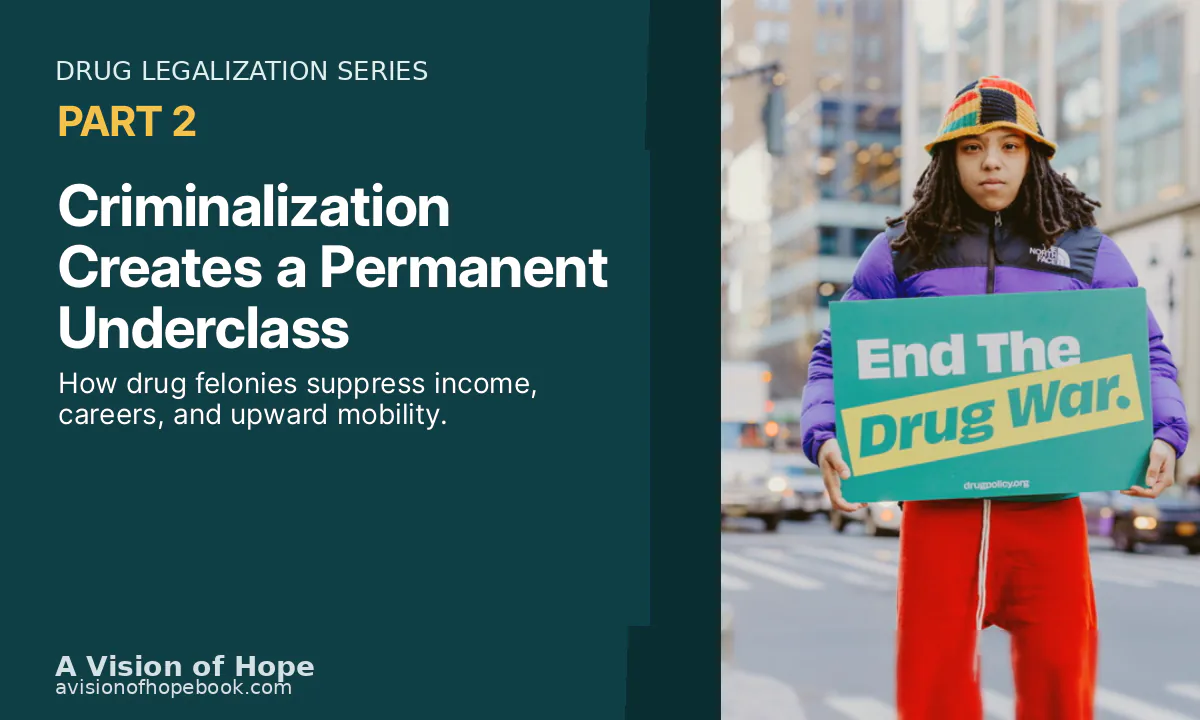
Drug Felony Consequences: How Criminalization Creates a Permanent Underclass
This is Part 2 of my Drug Legalization Series. If you are new here, start with:
Part 1: Punishment Doesn’t Produce Recovery
Part 1.5: Legalization vs Decriminalization vs Regulation
(Find it in the series hub)
What happens when drug use is treated as a crime?
When we label substance use and possession a crime, we do not just punish behavior.
We manufacture a permanent underclass.
Not temporarily.
Not “until they learn their lesson.”
We brand people early, then build systems that keep them down for years, sometimes for life.
I know because it happened to me.
And if you want the cleanest way to understand the damage, start here: drug felony consequences are not mainly about jail time. They are about everything that comes after.
What did a drug felony at 19 do to my life?
I was convicted of a felony possession charge at 19 years old.
After that, my life followed a familiar pattern for people with records: menial job to menial job, applications that went nowhere, interviews that ended the moment background checks entered the conversation.
I am not exaggerating. The system is built to work this way.
When you carry a felony record, especially tied to substances, the system treats you as a permanent risk, even when you get sober, even when you do everything you are told to do.
For me, the way out eventually came through sales. It was one of the few fields where performance could outvote paperwork. But I did not find that path quickly. The record kept me trapped in poverty for years.
That is what felony drug possession consequences look like in real life. People call it “a mistake,” but the record held my future back for years.
How many people have a criminal record?
The Brennan Center estimates that more than 70 million people in the United States have a criminal record.[1]
That is a large share of the workforce, and every one of them is flagged on a background check.
Once the flag is there, it shows up everywhere. Jobs. Housing. Credit. Licenses. Education. Even when someone has changed.
This is what people mean when they talk about the collateral consequences of conviction.[3]
How does a drug felony affect getting a job?
Employment is the single strongest stabilizing factor for recovery and reentry.
And we block it by design.
The Brennan Center summarizes research showing:
-
incarceration reduces annual earnings by an average of 52 percent
-
a felony conviction alone reduces annual earnings by about 22 percent[1]
The lost income keeps adding up for years after the sentence ends.
And it gets enforced quietly through criminal record employment discrimination.
In one widely cited audit study, Devah Pager’s work found that a criminal record can cut the likelihood of a callback roughly in half.[2]
So people are told to “work hard” while the hiring pipeline is built to shut them out.
That is how employment barriers become permanent.
Does a drug felony affect promotions and career growth?
Even when someone with a record gets hired, the ceiling stays low.
Records can block:
-
supervisory roles
-
positions of trust
-
advancement into licensed professions
-
internal promotion tracks
Managers fear liability. HR departments default to risk avoidance. Career ladders quietly vanish.
So the system creates the conditions for instability, then calls the instability proof that people cannot change.
Can you rent housing with a drug felony?
You need stable housing to stay in recovery. Without it, keeping a job, getting to treatment, and staying sober all get harder.
But criminal record housing barriers are everywhere in practice, even when the law does not explicitly require them.
Tenant screening is a major driver. The federal government has brought enforcement action alleging that tenant screening reports can include inaccuracies and are used to make life-altering housing decisions.[5]
HUD has also emphasized that the Fair Housing Act can be implicated when housing providers use criminal history policies that create discriminatory effects.[4]
Here is the real-world loop:
-
no housing means higher stress
-
higher stress increases relapse risk
-
relapse increases supervision violations
-
violations reinforce the label
Each step feeds the next one, and none of it makes anyone safer.
And when we talk about housing barriers, we are talking about the difference between stability and collapse.
How does a criminal record affect credit?
Most people do not think of credit as part of criminal punishment.
It becomes one anyway.
The CFPB has documented how justice involvement can damage financial stability through fees, debt, and limited consumer choice, and how incarceration can make it harder to manage credit and financial obligations.[6]
Credit affects:
-
renting
-
transportation
-
insurance rates
-
sometimes employment
So even when someone is working, the financial system continues to penalize them.
This is one of those drug felony consequences nobody explains at sentencing, but people live with for years.
Can you get financial aid or job training with a drug conviction?
Federal policy has improved in at least one major way.
A U.S. Department of Education Dear Colleague Letter explains that the 2023-24 FAFSA no longer contains selective service or drug conviction questions.[7]
That removed one barrier for students with drug convictions.
But the chilling effect remains. Even when eligibility rules change, the stigma and fear of the process still block people from:
-
certain training programs
-
internships
-
professional pathways
-
licensed careers
A felony at 19 can derail education before it begins.
Holding someone accountable should not mean closing off their future.
Can a drug felony stop you from getting a professional license?
One of the least discussed “hidden sentences” is licensing.
The National Inventory of Collateral Consequences of Conviction catalogs 40,000-plus legal restrictions across the U.S., including barriers tied to employment, business, and licensing.[3]
Licensing is one of the most reliable ladders into stable, middle-class work.
When those ladders are removed, people get pushed toward low-wage instability or the informal economy.
Then policymakers act surprised when the informal economy grows.
Why is drug policy also economic policy?
Criminalization increases arrests. It also lowers lifetime earnings, blocks people from moving up, and keeps them unstable.
We are funding poverty and calling it justice.[1]
And when that “poverty engine” is aimed at people with addiction histories, it also becomes a relapse engine.
Why do I argue for regulation over punishment?
None of this is an argument for “no accountability.”
Accountability should focus on harm:
-
impaired driving
-
violence
-
coercion
-
theft
-
trafficking outside a regulated system
-
violations of safety rules
But possession and use should not trigger lifelong exclusion.
That is why I keep arguing for drug legalization and regulation.
Because if the goal is fewer overdoses, safer communities, and less chaos, we need fewer people trapped in desperation with no legitimate path forward.
That is harm reduction in plain language: keep people alive, reduce instability, and stop feeding the conditions that make relapse and violence more likely.
This is also the core of drug policy reform that actually works: reduce harm, reduce trauma, reduce desperation, and stop outsourcing “control” to cages.
It is treatment over punishment, not because it sounds nice, but because punishment is producing the opposite of stability.
What would real reform look like?
If policymakers want to stop manufacturing an underclass:
-
Stop criminalizing possession and use as the default response
-
Expand automatic record sealing and expungement
-
Reform licensing laws to focus on actual risk, not moral judgment
-
Limit blanket housing exclusions and require individualized review
-
Measure success by outcomes: housing stability, employment stability, overdoses, and recidivism, not arrest counts
If you want the definitions and why they matter, read Part 1.5 in the series hub here:
Does a drug felony affect voting rights?
There is another mechanism that reinforces the underclass: stripping civic voice through felony disenfranchisement and supervision-based voting bans.
That deserves its own post. It is Part 3 in this series.
What is the bottom line?
If your drug policy creates permanent poverty, it is not public safety policy.
It is a poverty engine.
I lived with the brand for years. I found a way out, but it took time, and it should not require luck.
Criminal records do not create recovery.
Punishment does not create stability.
Regulation does.
If you want to follow the full series as it publishes, visit the full Drug Legalization Series.
If you prefer audio conversations on recovery, reentry, and purpose, check the podcast page.
For program directors building reentry and transition programming, see ReturnPath reentry curriculum.
For the personal story behind this work, read A Vision of Hope.
To invite Andrew for a keynote or panel, see speaking.
If you or someone you love is struggling, help is available. SAMHSA’s National Helpline is available 24/7 at 1-800-662-HELP (4357).
Frequently Asked Questions
What are the community and reentry consequences of drug criminalization?
The record follows people past sentencing into the whole community they come home to: fewer job callbacks, denied rentals, damaged credit, and licensing locked out of entire fields. More than 70 million people in the United States carry a criminal record, so this is not a small, isolated group; it is a large share of the workforce and the neighborhoods they live in carrying the same brand.[1] Reentry gets harder, not easier, as housing instability raises relapse risk, relapse raises the odds of a supervision violation, and the violation reinforces the record that started the cycle.
What are felony drug possession consequences beyond jail time?
Drug felony consequences often continue long after sentencing. They can include reduced job opportunities, lower lifetime earnings, barriers to housing and rentals, licensing restrictions, and ongoing financial instability that makes recovery and reentry harder.
How does a felony drug conviction affect employment and income?
Criminal convictions and incarceration are associated with significant reductions in earnings and employment opportunities. Even when someone is qualified, background checks and stigma often reduce callbacks, limit promotions, and shrink access to stable career tracks.
Can a criminal record affect housing and rental applications?
Yes. Many landlords and property managers use tenant screening reports that may include criminal records, eviction records, and credit history. Errors and blanket screening practices can lead to denials and instability, which makes recovery and reentry harder to sustain.
Do criminal records affect credit and financial stability?
Often, yes. Justice involvement is frequently tied to financial strain through disrupted employment, fees, fines, debt, and limited access to basic financial products. Those pressures can damage stability and slow reintegration even after someone is doing the right things.
Do drug convictions affect federal student aid eligibility?
Currently, federal student aid guidance states that drug convictions no longer affect eligibility for federal student aid. Policies have changed over time, so it is still worth confirming details for individual situations.
What are “collateral consequences” of conviction?
Collateral consequences are legal and regulatory restrictions that can limit access to jobs, occupational licensing, housing, education, and other opportunities because of a conviction, even after someone has completed their sentence.
Is this argument saying there should be no accountability?
No. Accountability should focus on harm: impaired driving, violence, coercion, theft, trafficking outside a regulated system, and violations of safety rules. The argument is that possession and use should not trigger lifelong penalties that trap people in poverty and instability.
What policies reduce the “permanent underclass” effect?
Common reforms include ending criminal penalties for possession and use, expanding record sealing and expungement, fair chance hiring, fair chance licensing, limiting blanket housing exclusions, and investing in treatment and recovery supports that reduce relapse and recidivism.
References
[1] Brennan Center for Justice. Conviction, Imprisonment, and Lost Earnings: How Involvement with the Criminal Justice System Deepens Inequality.
https://www.brennancenter.org/our-work/research-reports/conviction-imprisonment-and-lost-earnings-how-involvement-criminal
[2] Presley Center (UCR). The Mark of a Criminal Record (summary of Devah Pager’s findings).
https://presleycenter.ucr.edu/article-compendium/2003/03/01/mark-criminal-record
[3] The Council of State Governments Justice Center. The National Inventory of Collateral Consequences of Conviction (NICCC).
https://csgjusticecenter.org/publications/the-national-inventory-of-collateral-consequences-of-conviction/
[4] U.S. Department of Housing and Urban Development (HUD). Implementation memo on Fair Housing Act standards and criminal records (June 10, 2022) (PDF).
https://www.fairhousingnc.org/wp-content/uploads/2022/08/06-10-2022-Implementation-of-OGC-Guidance-on-Application-of-FHA-Standards-to-the-Use-of-Criminal-Records-June-10-2022.pdf
[5] Federal Trade Commission. Complaint: United States v. TransUnion Rental Screening Solutions, Inc., and Trans Union LLC (Final Complaint). https://www.ftc.gov/system/files/ftc_gov/pdf/tu_turss_complaint_final.pdf
[6] Consumer Financial Protection Bureau. Justice-Involved Individuals and the Consumer Financial Marketplace (PDF)
https://files.consumerfinance.gov/f/documents/cfpb_jic_report_2022-01.pdf
[7] U.S. Department of Education, Federal Student Aid. Dear Colleague Letter GEN-22-15 (FAFSA Simplification Act changes; 2023-24 FAFSA removed drug conviction questions).
https://fsapartners.ed.gov/knowledge-center/library/dear-colleague-letters/2022-11-04/fafsar-simplification-act-changes-implementation-2023-24