
Table of contents
Direct Answer
A drug felony can take away your right to vote and your right to own a gun after the sentence ends. Voting rules depend on the state, and some states bar people on probation or parole or with unpaid fines. Federal law generally bars anyone convicted of a crime punishable by more than one year from having a firearm.
Voting, gun rights, and records: key numbers
Figures checked October 24, 2026, against the source pages linked below.
| Measure | Figure | Source (published) |
|---|---|---|
| Adults under community supervision (probation or parole) at yearend 2022 | 3,668,800 | BJS, Probation and Parole in the United States, 2022 (May 2024) |
| People in state criminal history files (50 states, D.C., and Guam), 2020 | 114,376,500 | BJS-funded Survey of State Criminal History Information Systems, 2020 (December 2022) |
| Firearm applications denied after background checks, 1994 to 2017 | 3.5 million (1.5%) | BJS, Background Checks for Firearm Transfers, 2016 to 2017 (February 2021) |
Supervision counts include people on probation or parole for any offense. Firearm denials include every reason for denial, not only felony convictions.
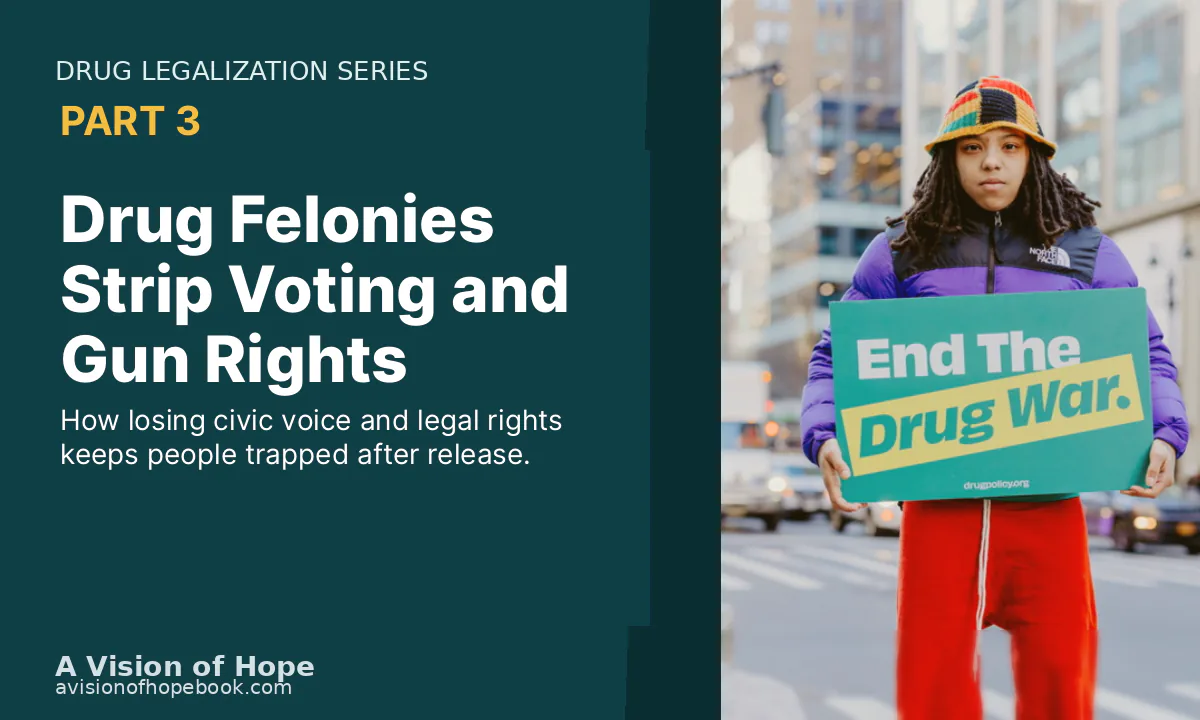
Drug Felonies Strip Voting and Gun Rights
How losing civic voice and legal rights keeps people trapped after release. A look at drug felony voting rights and gun rights impact.
Most people think the sentence is the sentence.
You serve your time, finish probation, and the case is closed.
But if you have a drug felony, that is not how it works in real life. There is the official sentence, and then there is the hidden sentence: the rights you lose, the doors that stay shut, and the ways the system quietly tells you you are not fully a citizen anymore.
I know because I lived it.
I was permanently branded at 19 years old with a felony drug possession conviction. For a long time, that brand did not just limit what jobs I could get. It shaped how I saw myself. It shaped what I believed I deserved. It shaped how “normal life” felt permanently out of reach.
And part of that is this: when the system strips your rights, it also strips your stake.
If you are new to this series, start with Part 1 Part 1: Drug Legalization.
If you want the definitions that critics like to blur, read Part 1.5 Part 1.5: Legalization vs Decriminalization vs Regulation: Drug Policy Explained.
And if you missed Part 2 on how criminalization creates a permanent underclass, it is Part 2: Drug Felony Consequences After Release.
This post is about two of the biggest “hidden sentence” consequences of drug felonies: voting rights and gun rights.
Can you vote with a drug felony?
When you label substance use disorder and drug possession as crimes, you create a pipeline into lifelong civic exclusion.
Felony disenfranchisement is not rare. It affects millions of Americans. The Sentencing Project estimates that more than 4 million people were denied the right to vote due to a felony conviction (using 2022 data). That count includes people living in the community, not only people in prison. [1]
Read that again.
Millions of Americans. Living, working, parenting, paying rent, paying taxes, and still treated as politically invisible.
That is what it means to create a permanent underclass. On top of poverty and stigma, people lose any say in the laws that govern them.
And the kicker is that these laws are not consistent. Your ability to vote can depend on what state you live in, what your conviction was, whether you are on supervision, and in some places, whether you still owe money.
This is how you get a country where “rights” are not rights. They are conditional privileges.
What happened with Florida Amendment 4 and unpaid fines and fees?
This is the example policymakers need to face head-on: even when the public votes for rights restoration, the system can find a way to keep the penalty alive.
Florida passed Amendment 4, widely described as a voting rights restoration measure. Then Florida passed implementing legislation (SB 7066) that tied restoration to “completion” in a way that includes legal financial obligations. [2]
In plain language: you can be off supervision, back in the community, trying to rebuild, and still be blocked from voting because you cannot pay fines, fees, or restitution.
That is a pay-to-vote barrier.
You cannot claim you support reintegration while you keep people politically voiceless until they can afford their freedom.
You cannot claim you support “personal responsibility” while maintaining a system where debt becomes the gatekeeper to citizenship.
The harm is real and practical. It keeps entire groups of people out of decision-making about schools, housing policy, public health funding, workforce development, and criminal justice reform, which are the policies that shape whether reentry succeeds.
Why does voting rights restoration help recovery and reentry?
The right to vote is one of the strongest “belonging signals” society can give.
When a person is trying to rebuild after addiction or incarceration, their environment is either reinforcing identity change or reinforcing the old label.
Voting tells a person they are back and part of their community, and that their voice counts.
After I finished parole in Wisconsin, I voted in the 2020 presidential election, and The Journal Times profiled that moment alongside others rebuilding their civic voice after release.
Removing that signal tells someone: you are still an outsider.
If you want fewer relapses, fewer overdoses, less recidivism, and more stability, you do not do it by isolating people from civic life.
You do it by rebuilding connection, dignity, and stake.
There is also a practical point here: when people are cut off from civic participation, policy gets easier to ignore. If you want systems that help people rebuild, you do not design them around political invisibility.
Some research also suggests civic participation is associated with better outcomes, including lower arrest rates in some contexts, though any one study is not the entire story. [3]
Can you own a gun after a felony drug conviction?
This part is controversial, so I want to talk about it plainly.
A felony conviction can take away the right to possess firearms under federal law. The core federal prohibition is in 18 U.S.C. § 922. [4]
If you are reading that and thinking, “Good,” you are allowed to feel that way.
But you should also ask what the policy is actually doing, and whether it is doing what we claim it is doing.
A nonviolent drug felony can trigger long-term or lifetime firearm disability, even when the person has completed supervision, stayed sober for years, built a family, and lived peacefully.
That penalty is not about anything the person is doing now. It punishes them for life for what they did in the past.
And here is the issue that lawmakers avoid: broad, lifelong rights restrictions can backfire by keeping people in a permanent “other” category, even when they are doing everything society claims to want.
If the goal is public safety, the system should be able to distinguish between:
-
active violence risk
-
active criminal behavior
-
past addiction or possession history
A lifetime penalty that treats every case the same ignores the differences between people.
(Also worth stating clearly: nothing in this post is legal advice. Anyone trying to determine eligibility should check official state resources and qualified legal counsel.)
How does criminalizing drug use keep people locked out?
When you criminalize drug possession and addiction, you do not just punish a behavior. You reshape a person’s life trajectory through:
-
lost voting rights (drug felony voting rights restrictions)
-
lost legal rights
-
rules that vary by state, often confusing and hard to navigate
-
a permanent “second class” label that follows people long after they have changed
This is why I keep arguing that legalization with strict regulation is not about endorsing drug use.
It is about governing reality instead of surrendering it to the black market. It is also about stopping the policy choice that turns health issues into lifelong civic penalties.
That is the throughline of this series. If you want the definitions and the blueprint for what “regulation” actually buys us, read Part 1.5.
What would better policy look like?
If policymakers want reentry to work, the reforms are not complicated. They are politically uncomfortable.
-
Restore voting rights automatically and clearly
Make it automatic, with no maze of paperwork, no case-by-case approval, and no link to unpaid court debt. -
Stop using legal financial obligations as a citizenship gate
If a person owes restitution, enforce restitution through normal civil mechanisms. Do not turn the ballot into collateral. -
Make felony voting rights restoration simple, public, and verifiable
People should be able to confirm their status without risking a new charge for misunderstanding complex rules. -
Separate drug use from civic exclusion
If your stated goal is stability, you cannot keep stability out of reach.
Is the hidden sentence a policy choice?
When people hear “felony,” they picture violence.
But a drug felony can be possession. It can be addiction. It can be the worst season of someone’s life frozen into a permanent legal identity.
And that identity comes with penalties that were never part of any honest public debate.
If we care about safety, recovery, and reintegration, we have to stop confusing permanent exclusion with accountability.
Accountability is about harm.
Permanent civic punishment is about control.
If you want to follow the full series as it publishes, visit the full Drug Legalization Series.
If you prefer audio conversations on recovery, reentry, and purpose, check the podcast page.
For program directors building reentry and transition programming, see ReturnPath reentry curriculum.
For the personal story behind this work, read A Vision of Hope.
To invite Andrew for a keynote or panel, see speaking.
Frequently Asked Questions
Do drug felonies take away voting rights?
In many states, a felony conviction can restrict voting rights during incarceration, probation, parole, or beyond. The rules vary widely by state, and some states also tie restoration to financial obligations. [1]
What is felony disenfranchisement?
Felony disenfranchisement is when a person loses the legal right to vote because of a felony conviction, sometimes temporarily, sometimes for years, and in some states effectively indefinitely without additional steps. [1]
Can voting rights be blocked even after supervision ends?
Yes. Some systems treat “completion” as more than finishing time and supervision. In Florida, restoration has been tied to legal financial obligations like fines, fees, and restitution. [2]
Is this basically “pay to vote”?
When voting access is conditioned on paying fines, fees, or restitution, it creates a barrier where people with money can regain rights faster than people without money. Critics describe this dynamic as pay-to-vote. Florida’s SB 7066 is part of why this became a major issue after Amendment 4. [2]
Do drug felonies remove gun rights?
A felony conviction can trigger federal firearm disability, which prohibits firearm and ammunition possession for people convicted of crimes punishable by more than one year, with limited exceptions. [4]
Are voting and gun-rights rules the same everywhere?
No. Voting rights and restoration processes vary by state. Firearm restrictions can involve both federal and state law. If someone is trying to determine personal eligibility, they should check official state election resources and qualified legal counsel.
How does losing rights affect recovery and reentry?
Losing rights reduces civic belonging and keeps people in a permanent outsider category, which can undermine stability, employment, and identity change after release. Some research also links voting to better post-release outcomes in certain samples. [3]
References
-
The Sentencing Project. Locked Out 2024: Four Million Denied Voting Rights Due to a Felony Conviction. https://www.sentencingproject.org/reports/locked-out-2024-four-million-denied-voting-rights-due-to-a-felony-conviction/
-
Florida Senate. SB 7066 (2019): Implementation of Amendment 4. https://www.flsenate.gov/Session/Bill/2019/7066
-
Uggen, C., and Manza, J. Voting and Subsequent Criminal Arrest: Evidence from a Community Sample. The Annals of the American Academy of Political and Social Science (2006).
-
Cornell Law School, Legal Information Institute. 18 U.S. Code § 922. https://www.law.cornell.edu/uscode/text/18/922