
Table of contents
This page is part of the Drug Legalization Series. For Part 1, start with Drug Legalization Isn’t Endorsement.
Direct Answer
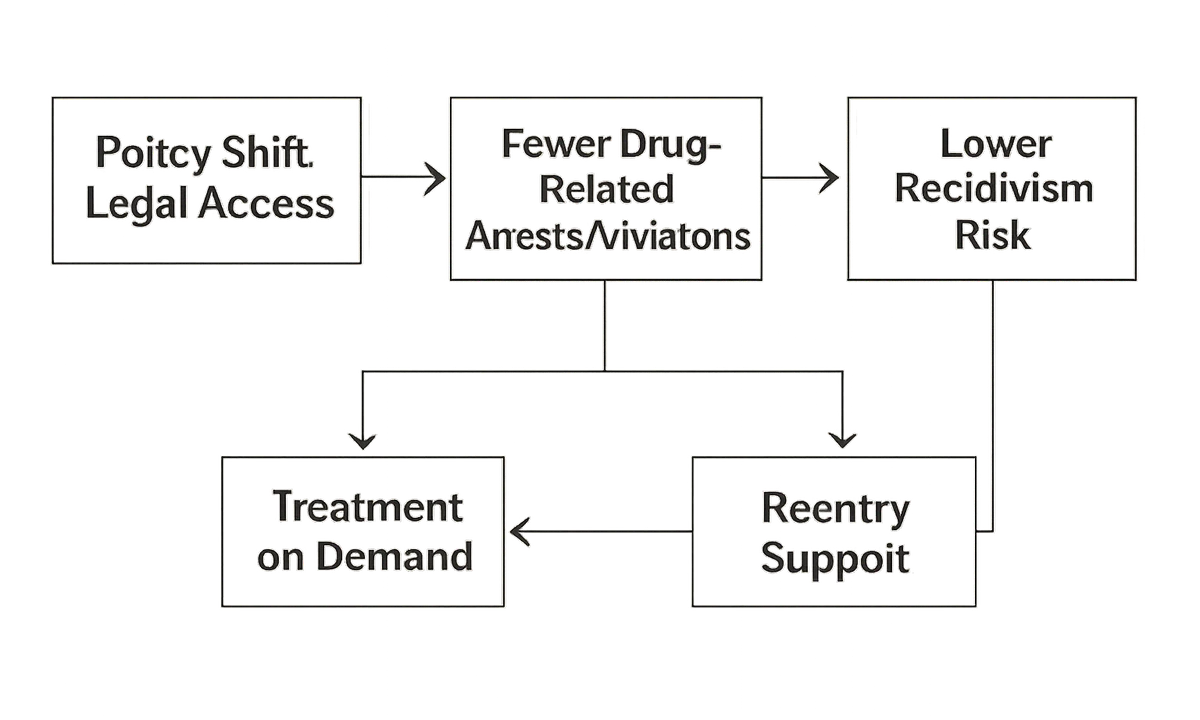
Drug legalization can lower recidivism by removing possession arrests and the probation violations tied to them. It does not fix the rest on its own. BJS found 71% of people released from state prison in 2012 were rearrested within five years. Treatment, housing, and reentry support decide most of what happens next.
Recidivism and reentry: key numbers
Figures checked October 24, 2026, against the source pages linked below.
| Measure | Figure | Source (published) |
|---|---|---|
| People released from state prison in 2012 (34 states) who were arrested within 3 years | 62% | BJS, July 2021 |
| Same group arrested within 5 years | 71% | BJS, July 2021 |
| Same group returned to prison within 5 years for a parole or probation violation or a new sentence | 46% | BJS, July 2021 |
| People released from state prison in 2008 (24 states) arrested within 10 years | 82% | BJS, September 2021 |
| Same group returned to prison within 10 years | 61% | BJS, September 2021 |
| Estimated share of the U.S. prison population with an active substance use disorder | 65% | NIDA (NIH), Criminal Justice DrugFacts |
| Share of people with opioid use disorder in jail and prison who get medication treatment | 5% | NIDA (NIH), Criminal Justice DrugFacts |
| Risk of death in the first 2 weeks after release compared with other state residents (Washington State, 1999 to 2003 releases) | 12.7 times higher | Binswanger et al., NEJM 2007 (PubMed, NIH) |
These BJS numbers cover everyone released from state prison, not only people convicted of drug crimes.
What does recidivism mean?
Recidivism usually means one of three things inside a set follow-up window: a new arrest, a new conviction, or a return to prison. BJS counts a return to prison for a parole or probation violation the same as a return for a new sentence. When you read a recidivism number, check which of those it is and how many years it covers. A three-year arrest rate and a ten-year prison return rate are not the same measure.
How could drug legalization lower recidivism?
Possession charges and drug-related technical violations are a common way back into custody. A positive drug test can violate probation or parole even when there is no new crime. If possession is no longer a crime, that pathway gets smaller. Fewer people pick up new drug records, and fewer records means fewer barriers to jobs and housing. For more on what a drug record costs a person after the sentence ends, see how a drug felony follows you after release and drug felony voting and gun rights.
Does legalization alone reduce recidivism?
No. Removing possession crimes takes away one route back to custody, but recidivism also tracks housing loss, untreated substance use disorder, weak reentry support, and supervision rules. NIDA estimates 65% of people in U.S. prisons have an active substance use disorder, and only about 5% of people with opioid use disorder in jails and prisons get medication treatment. Legal access without treatment does not address that. For what has happened in places that tried it, see drug decriminalization case studies and drug policy reform outcomes.
Why are the first weeks after release so risky?
The first weeks after release carry the highest risk of overdose death. A Washington State study published in the New England Journal of Medicine found that in the first two weeks out, former prisoners died at 12.7 times the rate of other state residents, and drug overdose was the leading cause of death. Tolerance drops inside. People go back to the amount they used before. NIDA notes that overdose deaths after release were lower when people got medication for their addiction. For the full picture, see prison release overdose risk and a reentry story: coming home after ten years.
What has to come with legalization to lower recidivism?
Treatment on demand, including medication for opioid use disorder, started inside and continued after release. Housing. A real reentry plan. Rules for impaired driving and sales to minors, so legal access comes with accountability. The difference between legalization, decriminalization, and regulation changes which of these a state actually builds. See legalization vs decriminalization vs regulation.
Frequently Asked Questions
Does drug legalization reduce recidivism?
It can lower recidivism by removing possession arrests and the probation violations tied to them. It does not fix the rest on its own. BJS found 71% of people released from state prison in 2012 were rearrested within five years. Treatment, housing, and reentry support decide most of what happens next.
Does legalization alone reduce recidivism?
No. Removing possession crimes takes away one route back to custody, but recidivism also tracks housing loss, untreated substance use disorder, weak reentry support, and supervision rules. Legal access without treatment and reentry support is incomplete reform.
What is the recidivism rate in the United States?
BJS found that 62% of people released from state prisons in 34 states in 2012 were arrested within 3 years and 71% within 5 years. 46% returned to prison within 5 years for a parole or probation violation or a new sentence.
Why does reentry matter for recidivism after drug convictions?
The first two weeks after release carry the highest risk of death, mostly from overdose. Cutting drug-related justice contact helps only when release includes treatment that continues outside, housing, and practical reentry support. See prison release overdose risk and how a drug felony follows you after release.
Sources
- Bureau of Justice Statistics. Recidivism of Prisoners Released in 34 States in 2012: A 5-Year Follow-Up Period (2012 to 2017). July 2021.
- Bureau of Justice Statistics. Recidivism of Prisoners Released in 24 States in 2008: A 10-Year Follow-Up Period (2008 to 2018). September 2021.
- National Institute on Drug Abuse. Criminal Justice DrugFacts.
- Binswanger IA, et al. Release from prison: a high risk of death for former inmates. New England Journal of Medicine, 2007.
Related reading
- Drug Legalization Series
- Prison release overdose risk
- Drug decriminalization case studies
- Drug policy reform outcomes
- Halfway house reentry curriculum guide
- ReturnPath curriculum hub
- Speaking: Andrew Drasen on recovery, reentry, and drug policy from lived experience.