
Table of contents
WISCONSIN JUSTICE & REENTRY
PART 8
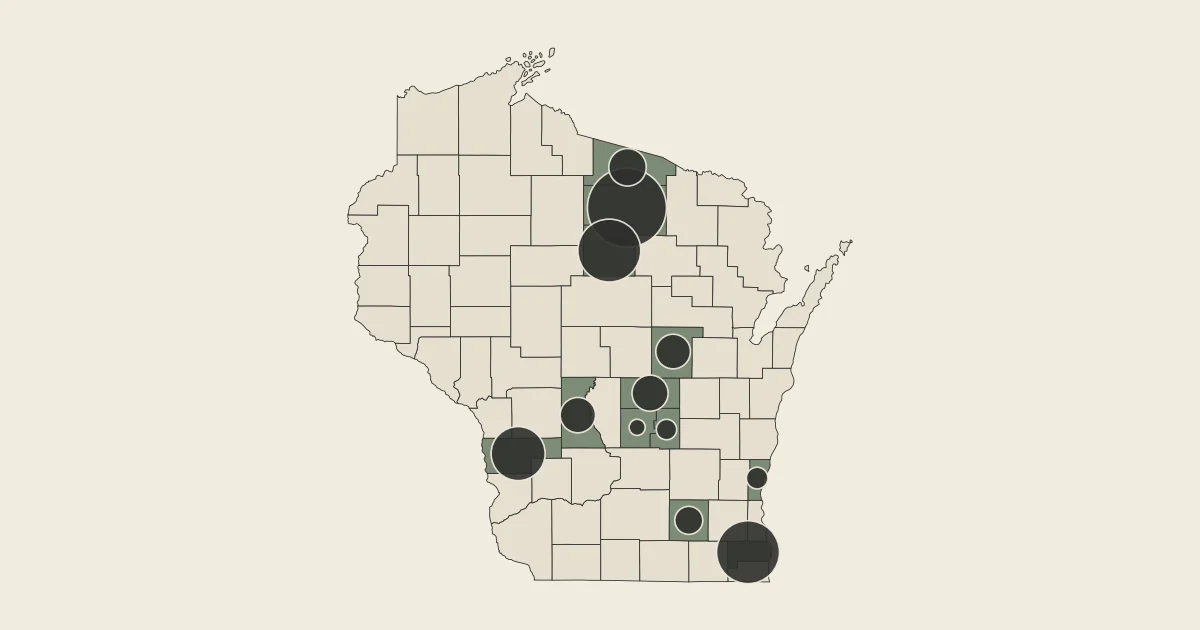
Every Friday, the Wisconsin Department of Corrections posts a count of everyone in its care. When you scroll through it, most of the names are prisons you would expect. Near the bottom of the men’s page there is a list of county jails. On October 30, 2026, that list showed 120 men in the Oneida County Jail, 76 in Lincoln County, 76 in Racine County, and 56 in Vernon County. Twelve county jails held 452 men that day, and two of them also held 12 women.[1]
Those people were not waiting for court. They were serving state prison sentences in buildings run by county sheriffs.[1][2]
Part 2 described contract beds as overflow for a crowded prison system.[13] This part looks at the same beds from the side of the person in them. Who gets sent? What changes when the building changes? Who decides? It also connects to Part 7. DAI’s own policy limits these placements to the last twelve months before release, which is the year that sets up the first year home.[3][15]
Direct Answer
Wisconsin law lets DOC contract with a local government to house people sentenced to state prison in a county jail, a county house of correction, or a tribal jail. The rate may not exceed $60 per person per day.[2] DOC paid counties $51.46 a day from 2004-05 until fall 2024, when it moved every contract to $60.[5]
Under the Division of Adult Institutions (DAI) policy on these placements, the list is short. A person has to be within 12 months of release and in minimum community custody, with no pending charges or detainers. Health and psychological services have to clear them. The warden and the sheriff both have to approve.[3]
Once there, the person follows jail rules. DOC does not pay wages for jail jobs, and the policy says program completions in the jail may not count toward the needs DOC identified.[3] But the same law also lets the sheriff and DOC allow someone to leave during the day to work, look for work, train, or go to school.[2]
Three kinds of state cases in a county jail
The words “contract beds” cover more than one thing. In a DOC budget, most of the money on that line is not for state prisoners in county jails.[4][5]
| Who is in the jail bed | What puts them there | How long | What DOC pays |
|---|---|---|---|
| Person serving a state prison sentence | Contract under Wis. Stat. § 302.27 | Part of the sentence; DAI policy limits placement to the last 12 months | Up to $60 a day; $60 since fall 2024 |
| Person on supervision with a sanction | Signed statement admitting a rule violation | Up to 90 days | $60 a day |
| Person on supervision held for revocation | Department hold while the revocation case is open, with no new criminal charge pending | Until the revocation is decided | $40 a day reimbursement |
The table draws on the statutes and the LFB budget paper.[2][5][7]
In fiscal year 2023-24, there were about 717 contract beds a day on DOC’s bill. About 166 of those were people serving prison sentences in ten county jails. Most of the rest, about 533, were extended supervision sanction beds. The prison-sentence beds cost $3.1 million that year; the sanction beds cost about $10 million.[4]
So it helps to ask which row someone means when they talk about contract beds in Wisconsin.
The October 30 count still shows the same split. Besides the 464 state prisoners, there were 267 people on supervision in county jail short-term sanction beds, out of 500 listed. Milwaukee Secure Detention Facility (where I did an alternative to revocation drug program in 2019) held another 561 people on community supervision that day.[1]
This essay is about the first row of that table: people with a prison sentence, doing part of it in a jail.
Who gets sent
DAI’s written policy, last updated in September 2024, sets the gate.[3]
Under DAI Policy 302.00.05, a person has to have 12 months or less to their adjusted release date to be eligible. They have to be in minimum community custody. They cannot have pending charges or detainers, and they cannot have refused the program needs DOC identified. The Health Services Unit has to clear them. Psychological Services has to clear them too. That means things like no suicide or self-harm in the past six months, no high monitors, staying on prescribed medication, and no threats or assaults during the current stay.[3]
The policy is written as a request. The person asks their social worker in writing. They sign release forms so the sheriff can read their file. The social worker checks that the county fits the agent of record and the county of release.[3]
The warden’s decision is final. When there is no contract with that county, DOC can ask the sheriff whether the jail is interested. If the request is denied, the person cannot ask again for six months.[3]
Either side can end it at any time: the county can ask DOC to take the person back, and DOC can remove the person and return them to a prison.[3] A 1997 court decision noted in the statutes also says sheriffs, as the keepers of their jails, can refuse to keep DOC detainees when keeping them would endanger jail safety.[8]
But the policy does not tell us how many of the 464 asked to be there. DOC also uses county beds to relieve crowding, and I could not find anywhere it reports how each placement started.[4][5]
What changes when the building changes
A county jail and a state prison are built for different jobs. County jails mostly hold three groups: people arrested locally, people waiting on court, and people serving jail sentences of a year or less. State prisons hold people with longer sentences.[9]
When someone moves to a county contract bed, DAI’s policy changes several things at once.[3]
| What changes | What DAI Policy 302.00.05 says |
|---|---|
| Rules | The person is subject to jail policies and rules. |
| Custody level | DAI classification custody is waived while they are in the jail. A reclassification hearing starts if they return to a DAI facility. |
| Pay | No DOC wages for work or program assignments the jail provides. |
| Programs | Other programs or jobs may be offered “as jail resources and policy permits,” and completions there “may not necessarily qualify” as addressing the needs DOC found. |
| Health care | The jail provides and pays for routine and emergency medical, mental health, and dental care. The policy warns that some of these jails do not have mental health staff on a regular basis. |
| Release planning | A DAI social worker still manages the case and the release plan with the person’s agent. |
That program line is the one I keep coming back to. The eligibility list says a person must not have refused their program needs. It does not say the needs were met.[3] In Part 6, the problem was people who reached the end of a sentence still on a waitlist.[14] Under this policy, someone in that position can spend the last months of the sentence in a building where a program finished there might not count.[3] To me, that is the biggest gap in the policy.
The county bed also has a real upside, and it is written into the law. A person in a contract bed can be allowed to leave during necessary and reasonable hours for things like looking for work, job training, working, community service, or school. The sheriff and DOC decide who is eligible, and either can end it.[2] Wisconsin has run work release out of county jails since the 1913 Huber Law.[11] The policy also lists going to office visits with a probation and parole agent.[3]
So the same placement can go two ways.
Take someone placed in the county they are going home to, with a job they can leave for each morning and their agent in the same county. That last year can be better than waiting on a prison unit for a program seat that never opens. But take someone placed far from home, in a jail with no work release slot and no program DOC will count. They spend the same twelve months waiting in a building made for short stays.[2][3][9]
What the state and the counties get
The arrangement works for the two governments that sign it.
DOC gets beds, and it needs them. On October 30, 2026, DOC listed 23,936 people in its adult institutions and contract beds, against a design capacity of 17,861.[1] DOC had contracts for about 529 county jail beds in 2025. Its budget projections counted on 283 county beds in 2025-26 and 356 in 2026-27 just for crowding.[5] Yet the October count was already above both.[1]
Counties get money. When Vernon County signed in 2023 to hold up to 50 state prisoners at $51.46 a day, the jail administrator estimated $940,000 a year at full use and about $500,000 after the county’s added costs, like wages, meals, and laundry.[10]
Oneida County has held state prisoners on and off since 1999. DOC ended county contracts in 2009, but Oneida signed again in 2016 for up to 100 people.[12] In 2020, WPR reported the contract was worth about $1.2 million a year to Oneida County. The county covers transportation, housing, and health care. It puts the rest in its capital budget. Deputies made a four-hour round trip to Stanley Correctional Institution each week to exchange people with the state.[9]
The rate is also a competition: counties can rent the same beds to federal agencies such as the U.S. Marshals. DOC told the Legislative Fiscal Bureau that one county was getting $80 a day from the Marshals, and another up to $100 a day for Immigration and Customs Enforcement detainees. DOC raised its own rate to $60 after requests from the Badger State Sheriffs’ Association, and it warned that counties might stop taking state prisoners otherwise.[5] The governor’s 2025-27 budget asked to raise the cap to $80. The Legislature left it at $60.[6]
Most of the contract terms are about running the jail.
LFB lists what the county agreements cover, such as transportation, health services, inmate programs and services, discipline, grievances, food, hygiene items, and clothing.[4] Still, I could not find any public report of what each county actually offers state prisoners. I also could not find how many are on work release, or whether their county bed matches the county they will release to. DOC does not even track work release participation across its own prisons.[11]
Is anyone in that chain doing something wrong? I think each of them is doing what the contract asks. The sheriff has beds and a budget to balance, and DOC has more people than beds.[1][9][10] But the person in the bed is the only one whose release plan depends on which county had room.
What I would change
The placement rules already exist. What is missing is a way to see whether they work. For me, the test is simple: can DOC show, county by county, that the last year in a jail moved people closer to home?
- Publish a county sheet. For each contract county, report how many state prisoners are there, how many are on work release, which programs are offered, and which of those DOC accepts toward a person’s needs.
- Report the release-county match. The policy already says the placement should fit the agent of record and county of release.[3] DOC should report how often it does.
- Do not move an unmet need into a building where it cannot be met. If DOC has a program need on someone’s file, the county placement should come with a program DOC will count, or the person should stay where the seat is.
- Tie any rate increase to the bridge. If the Legislature raises the cap again, the extra money should go with work release access and accepted programming, and not only with a bed.
These are my recommendations, not DOC’s. We should be able to check them against DOC’s own numbers every year.
The last year
A county contract bed is still prison time. The sentence keeps running, DOC keeps the case and the release date, and a DAI social worker still plans the release with the agent.[2][3][4]
The policy already limits county beds to the last year of a sentence, the same year that sets up the first year home. So that year should be decided by what gets someone ready to go home, not by which sheriff had room.
Programs and reentry teams can review the Reentry & Justice track, or send a short message. The rest of the argument is in the Wisconsin Justice & Reentry series. Plain definitions of the terms used here are in the Wisconsin justice system definitions.[16]
Frequently Asked Questions
Can Wisconsin hold state prisoners in county jails?
Yes. Wis. Stat. § 302.27 lets DOC contract with local governments to house people sentenced to state prison in county jails, county houses of correction, or tribal jails.[2] On October 30, 2026, DOC counted 464 state prisoners in 12 county jails.[1]
How much does Wisconsin pay counties to hold state prisoners?
The law caps the rate at $60 per person per day. DOC paid $51.46 from 2004-05 until fall 2024 and now pays $60.[2][5] A 2025 proposal to raise the cap to $80 was not included in the final budget.[6]
Who is eligible for a county jail contract bed in Wisconsin?
Under DAI Policy 302.00.05, a person needs all of these: 12 months or less to release, minimum community custody, no pending charges or detainers, no refused program needs, and health and psychological clearance. The warden and the sheriff must both approve.[3]
Do programs completed in a county jail count toward DOC program needs?
Not necessarily. DAI’s policy says program completions in the jail “may not necessarily qualify” as addressing the needs DOC identified, and people do not earn DOC wages for jail jobs or programs.[3] But a person in a contract bed can still be allowed to leave for work or school under § 302.27.[2]
Can state prisoners in a county jail do work release?
They can be allowed to. The law lets a person in a contract bed leave during reasonable hours to seek work, train, work, do community service, or attend school. But the sheriff and DOC decide eligibility, and either can end it at any time.[2]
Are extended supervision sanctions the same as contract beds?
No. A sanction bed holds someone on supervision who signed a statement admitting a rule violation, for up to 90 days.[5] Still, both are paid from the same contract bed line, and in 2023-24 sanction beds made up about 533 of the roughly 717 contract beds DOC paid for each day.[4]
References
- Wisconsin Department of Corrections. Persons in Our Care on 10_30_2026 (weekly population report, DOC-302). Contract beds by county jail (Oneida 120, Lincoln 76, Racine 76, Vernon 56 men; Waupaca and Waushara women), short-term sanction beds in county jails, Milwaukee Secure Detention Facility community corrections beds, total population and design capacity. https://doc.wi.gov/DataResearch/WeeklyPopulationReports/fri_10_30_2026.pdf
- Wis. Stat. § 302.27: Contracts for temporary housing for or detention of persons on probation or prisoners. DOC may contract with a local unit of government for county jails, houses of correction, or tribal jails; rate may not exceed $60 per person per day; the sheriff and the department may let a person leave to seek employment, train, work, perform community service, or attend school. https://docs.legis.wisconsin.gov/statutes/statutes/302/27
- Wisconsin Department of Corrections, Division of Adult Institutions. Policy 302.00.05: PIOC Request for Placement in DOC Contracted Facilities (effective September 11, 2024). Eligibility (12 months or less to release, minimum community custody, no pending charges or detainers, health and psychological clearance, warden and sheriff approval), written request to the social worker, county of release, jail rules, custody waived, no DOC wages, program completions may not qualify, jail health care, return to a DAI facility. https://doc.wi.gov/DepartmentPoliciesDAI/3020005.pdf
- Wisconsin Legislative Fiscal Bureau. Adult Corrections Program, Informational Paper 60. January 2025. Contract bed spending and average beds in 2023-24 by county, extended supervision sanction beds, $51.46 per diem and $60 statutory maximum, county agreement terms, contract beds used to relieve overcrowding. https://docs.legis.wisconsin.gov/misc/lfb/informational_papers/january_2025/0060_adult_corrections_program_informational_paper_60.pdf
- Wisconsin Legislative Fiscal Bureau. Corrections: Adult Facilities, Inmate Populations, Prison Contract Bed Funding, and Population and Inflationary Costs, Paper 255. 2025-27 biennial budget. Rate in place since 2004-05 raised to $60 in fall 2024 after Badger State Sheriffs’ Association requests; U.S. Marshals $80 and Immigration and Customs Enforcement up to $100; about 529 county jail beds under contract; projections of 283 and 356 county beds; sanction beds for a signed admission, up to 90 days. https://docs.legis.wisconsin.gov/misc/lfb/budget/2025_27_biennial_budget/302_budget_papers/255_corrections_adult_facilities_inmate_populations_prison_contract_bed_funding_and_population_and_inflationary_costs.pdf
- Wisconsin Legislative Fiscal Bureau. Comparative Summary of Provisions, 2025 Act 15: Corrections. August 2025. Governor proposed raising the contract bed cap from $60 to $80; the Legislature did not include it. https://docs.legis.wisconsin.gov/misc/lfb/budget/2025_27_biennial_budget/200_comparative_summary_of_provisions_2025_act_15_august_2025_by_agency/corrections.pdf
- Wis. Stat. § 302.33: Maintenance of prisoners in county jail; state payments to counties and tribal governing bodies. DOC reimburses $40 per person per day for people held on a department hold pending revocation, with no pending criminal charges. https://docs.legis.wisconsin.gov/statutes/statutes/302/33
- Wis. Stat. § 302.31 and annotation citing DOC v. Kliesmet, 211 Wis. 2d 254, 564 N.W.2d 742 (1997): sheriffs may refuse to keep department detainees if doing so will endanger jail safety. https://docs.legis.wisconsin.gov/statutes/statutes/302/31
- Mentzer R. Rising Inmate Population In Wisconsin Strains Local Jails. WPR. January 16, 2020. County jails hold people arrested locally, awaiting court, or serving a year or less; Oneida County contract worth about $1.2 million a year; county covers transportation, housing, and health care; weekly round trip to Stanley to exchange inmates. https://www.wpr.org/justice/rising-inmate-population-wisconsin-strains-local-jails
- Vernon County renews contract to house 50 state inmates at the Vernon County Jail. VernonReporter. September 28, 2023. $51.46 per inmate per day, $940,000 a year at the maximum 50, about $500,000 net after expenses. https://vernonreporter.com/vernon-county-renews-contract-to-house-50-state-inmates-at-the-vernon-county-jail/
- Yahr N. Wisconsin’s work-release program promises opportunity. Prisoners say jobs are scarce. Wisconsin Watch. December 15, 2025. The 1913 Huber Law created work release at county jails; DOC does not consistently track work release participation. https://wisconsinwatch.org/2025/12/wisconsin-corrections-prison-work-release-jobs-employers-minimum-security/
- Krall K. State Prisoners To Return To Oneida County Soon. WXPR. May 30, 2016. Oneida County housed state inmates beginning in 1999; DOC ended county contracts in 2009; new contract for up to 100 state inmates. https://www.wxpr.org/government/2016-05-30/state-prisoners-to-return-to-oneida-county-soon
- Drasen A. The Bottleneck of Bureaucracy: How Wisconsin Moves the Prison Pressure Around. A Vision of Hope. August 14, 2026. https://www.avisionofhopebook.com/insights/justice-public-policy/wisconsin-reentry-bureaucracy-bottleneck
- Drasen A. Wisconsin Program Waitlists and Short Sentences. A Vision of Hope. October 16, 2026. https://www.avisionofhopebook.com/insights/justice-public-policy/wisconsin-program-waitlists-short-sentences
- Drasen A. Wisconsin’s First-Year Cliff After Prison. A Vision of Hope. November 6, 2026. https://www.avisionofhopebook.com/insights/justice-public-policy/wisconsin-first-year-cliff
- Drasen A. Wisconsin Justice System Definitions. A Vision of Hope. September 25, 2026. https://www.avisionofhopebook.com/insights/justice-public-policy/wisconsin-justice-system-definitions