
Table of contents
When I was on extended supervision, I was charged with a new felony. My agent was going to push for revocation. I sat in county jail on an ES hold for nine months. Then I signed my revocation papers and went to a reconfinement hearing. I wrote about that process in Truth in Sentencing and Losing Street Time.[1]
A charge started that path. A charge is an accusation. It is not a conviction.[2]
The point is that difference. That is the whole fight over this bill.
What does a charge actually prove? On its own, nothing but an accusation.
In 2025, the Wisconsin Legislature passed a bill that would have required the Department of Corrections to recommend revocation whenever someone on extended supervision, parole, or probation was charged with a crime.[3] Governor Tony Evers vetoed Assembly Bill 85 on August 8, 2025.[4] On May 13, 2026, the Assembly failed to pass the bill over that veto.[5] The bill is not the law. The argument behind it is still worth spelling out, because it turns on a distinction people mix up all the time.
Direct Answer
A criminal charge is an accusation. A conviction is what comes after guilt is established, either by a guilty or no-contest plea or by a finding of guilt at trial.[2]
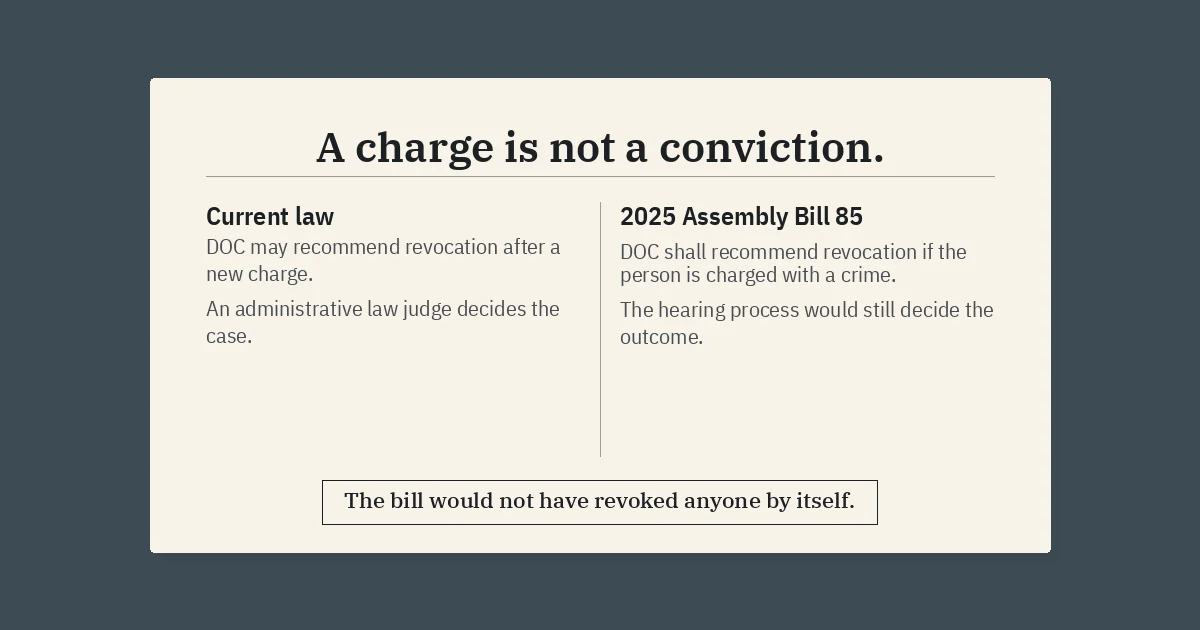
Under current law, if someone on supervision is charged with a new crime, DOC may take that person into custody to investigate an alleged violation, and it may recommend revocation. It is still not required to recommend it. In its fiscal estimate for the bill, DOC wrote that it uses department policy, evidence-based practices, administrative code, and the statutes to decide whether to recommend revocation in those cases.[6][7] If revocation is contested, an administrative law judge in the Division of Hearings and Appeals decides the case.[2]
So why did a bill about a recommendation cause a fight this large?
Because the recommendation is what starts the formal revocation path, and the bill would have made that start automatic once a charge was filed.
2025 Assembly Bill 85, and its Senate companion, Senate Bill 93, would have changed that. The bill would have required DOC to recommend revocation of extended supervision, parole, or probation if the person was charged with a crime while on that form of release.[3] It would not have revoked anyone by itself. The hearing process would still have decided the outcome.[3][6] What it would have taken away is the department’s ability to decide that a charge, on its own, is not enough to recommend revocation.
DOC’s official fiscal estimate, dated March 13, 2025, said the bill would add 4,673 people to the prison population once the increase was annualized. It estimated operations costs of $85,243,100 in the first year and $245,736,300 a year after that, not counting construction.[6] The governor’s veto message cited a fiscal impact of more than $330 million in the first two years, plus likely construction costs and local government costs that were not included.[4] Those first-two-year figures match the department’s two operations totals added together.
What is the difference between a charge and a conviction?
This series already has a plain definitions page for these terms. The short version is this: a charge is an accusation, and a conviction is a finding of guilt.
A charge means the state is alleging that a person committed a crime. It does not mean the person was convicted of it.[2] At the charging stage, the standard is not proof beyond a reasonable doubt. A charge can later be dismissed, reduced, or defeated at trial. It can also lead to a conviction. The charge itself is not the conviction.
A conviction is what comes after guilt is established. And the basic rule is this: charged and convicted are not interchangeable words.[2]
That difference gets blurred when someone is already on supervision. A new allegation can trigger a DOC hold, an investigation, or revocation proceedings before the criminal case is finished. Someone can be dealing with supervision consequences from a new charge while still legally presumed innocent in the new criminal case.[2] I was in that position. For me, the hold and the revocation case did not wait for the new criminal case to end.
For the rest of the terms in this piece, including holds, revocation hearings, and reconfinement, see Wisconsin Justice System Definitions.[2]
How does revocation work now?
For a person on extended supervision, the current statute says the person remains in the legal custody of the department. If the department alleges that a condition or rule of extended supervision has been violated, the department may take physical custody of the person for the investigation of the alleged violation.[7] The statute does not say the department must recommend revocation because a new criminal charge was filed.
If revocation is recommended and the person does not waive the hearing, an administrative law judge with the Division of Hearings and Appeals decides whether to revoke.[2] Who still decides the case after a recommendation? The ALJ does. The agent can recommend revocation. The ALJ decides the case.
There is also a shorter path that is not a full revocation. If a person on extended supervision signs a statement admitting a rule or condition violation, the department may, as a sanction, confine the person for up to 90 days in a regional detention facility or, with the sheriff’s approval, in a county jail.[7] But in its fiscal estimate, DOC wrote that under AB 85, that short-term sanction system would not be an option for people charged with a crime while on supervision.[6]
None of this means a new charge is ignored. But it does mean current law leaves room for a decision about what the charge should trigger.
What would AB 85 have required?
The Legislative Reference Bureau’s analysis of the bill is direct: under current law, a person released on extended supervision, parole, or probation is subject to conditions or rules, and a violation may be sanctioned, including by revocation. The bill would have required DOC to recommend revoking a person’s extended supervision, parole, or probation if the person was charged with a crime while on release.[3]
The bill would have amended four statutes: two extended supervision provisions, the parole statute, and the probation statute.[3] In each place, it would have added the same kind of sentence: if the person is charged with a crime, the department shall recommend that the person’s supervision be revoked.[3]
The bill was written to apply to charges filed on or after its effective date.[3] It would not have reached older charges.
Two limits are easy to miss, and both are in the bill text.
First, the required act was this: a recommendation, not a revocation. The hearing examiner or, if the hearing was waived, the secretary of corrections would still have entered an order revoking or not revoking.[3] DOC’s fiscal estimate made the same point: the department would have been required to recommend revocation, and the department assumed a share of those recommendations would be affirmed by an administrative law judge.[6]
But a required recommendation is still a required first step.
Second, the trigger was simple: being charged with a crime, not being convicted of one. The bill text does not require a plea, a verdict, or a conviction before the recommendation is required.[3]
AB 85 was introduced on February 28, 2025, by Representatives B. Jacobson, Donovan, Duchow, Maxey, Murphy, Penterman, Wichgers, and Knodl, and cosponsored by Senators Hutton, Bradley, Jacque, Nass, Tomczyk, James, and Wanggaard.[5] The Assembly passed it on March 13, 2025, by a vote of 53 to 43. The Senate concurred on June 18, 2025, by a vote of 18 to 14. The bill was enrolled on June 20, 2025, presented to the governor on August 7, 2025, and vetoed on August 8, 2025. On May 13, 2026, it failed to pass notwithstanding the governor’s objections.[5] Senate Bill 93 was the companion bill in the Senate.[5][8]
The bill never became law.
Current law and AB 85, side by side
Here is the difference in one place.
| Current law | 2025 Assembly Bill 85 | |
|---|---|---|
| What starts a supervision case after a new crime | A new charge can lead to a hold, an investigation, or a revocation recommendation. It does not, by itself, require a recommendation.[6][7] | If the person is charged with a crime, DOC shall recommend revocation.[3] |
| Who makes the first call | DOC decides whether to recommend revocation, using policy, evidence-based practices, administrative code, and the statutes, according to its fiscal estimate.[6] | The statute would have required the recommendation. The department would not have had that choice.[3] |
| Who decides revocation | An administrative law judge, or the secretary of corrections if the hearing is waived.[2][3] | The same hearing process. The bill would not have revoked anyone by itself.[3][6] |
| What the trigger is | An alleged violation of a rule or condition, which may include a new charge.[6][7] | Being charged with a crime, not being convicted of one.[3] |
| Short-term sanctions | For an admitted rule violation, DOC may use a sanction of up to 90 days in a regional detention facility or a county jail.[7] | DOC wrote that this option would not have been available for people charged with a crime.[6] |
What a required recommendation changes
A required recommendation is not the same thing as a required revocation. It is still a big change when the first step is no longer a judgment call.
What changes, then, if a judge still has the last word?
The path into that hearing changes. A revocation recommendation puts a person into a formal process that can end with a return to prison. It can also mean a long stay in a county jail while the case is open. I sat in jail for nine months on an ES hold before my reconfinement time was set.[1] That kind of hold is already available under current law. The bill would have made the recommendation that often follows a new charge a requirement rather than a judgment call.
The bill’s text does not sort charges by seriousness. It says “charged with a crime.”[3] That is a wide net. A charge can later be dismissed or reduced. Charges also range from low-level offenses to serious felonies. If someone was charged with either kind of offense, the department would have been required to recommend revocation. I’m describing how the text would have applied. I’m not claiming I know how an administrative law judge would have ruled in any one of them.
The same is true of a charge that should not have been filed. When a false accusation or a case of mistaken identity is filed, it is still a charge. The bill’s trigger is the charge, not the strength of the case.[3] I’m using those as examples of how the text reads, not as stories from my own record.
When I was in that documented case, my agent was already going to push for revocation after the new felony charge.[1] I’m not claiming the hearing result would have been different under AB 85. I think the recommendation would no longer have been a decision the department could make.
What DOC said the bill would cost
The only official fiscal estimate in the bill record is from DOC, dated March 13, 2025, and prepared for LRB number 25-1596/1.[6] The numbers below are that estimate, including the assumptions the department stated. They are not a prediction of what would have happened, and they are not a Legislative Fiscal Bureau score. Perhaps a later estimate would have used newer charge counts. This is the one in the bill record.
DOC used court data from fiscal year 2019 and estimated that 6,280 people on community supervision were charged with a new crime and remained on community supervision. Under the bill, the department would have been required to recommend revocation in all 6,280 of those cases, even when the criminal case later went nowhere.[6]
The department did not assume that every recommendation would become a prison sentence. In calendar year 2018, it had recommended revocation in 9,961 cases, and it wrote that about 87% of those recommended cases were revoked. For people on supervision who had a new conviction, it cited a fiscal year 2016 average of about 39 months of incarceration. It then said it was unknown whether those patterns would continue under the bill. It noted that both the revocation rate and the sentence length might decrease, because the department would have been required to recommend revocation for the charge of any crime, instead of deciding case by case.[6]
For the estimate itself, DOC assumed two figures: about 47% of the required recommendations would be affirmed, and the revocation sentences would be 19 months. On those assumptions, it estimated an average increased daily population of 1,599 people in the Division of Adult Institutions during the first year, and a permanent increase of 4,673 people once the population was annualized after 19 months.[6]
How much of that cost is a hard number, and how much is an assumption? Those figures only hold if those assumptions hold.
It also estimated that the Division of Hearings and Appeals would see 6,280 more revocation cases a year, at about $284 a case, or $1,786,800 a year in added charges to DOC.[6]
On cost, DOC used an average fiscal year 2024 cost of about $52,200 to hold one person in a DOC institution. It estimated increased operations costs, excluding construction, of $85,243,100 in the first year of enactment, and a permanent increased operations cost of about $245,736,300 after the population was annualized in the second year.[6] Add those two figures and the total is $330,979,400: the “more than $330 million in just the first two years” figure in the veto message.[4]
So the first-two-year total in the veto message is the department’s own operations totals added together, not a separate score.
The department also wrote that the prison population was getting close to capacity. It said it would likely need to build two new facilities, and that the cost to construct one new prison would be upwards of $1 billion, depending on location, size, and custody level. It marked local government costs as indeterminate. It said the population increase would ultimately depend on three things: the number of people charged, the rate at which administrative law judges affirmed the recommendations, and the length of reincarceration. It was working to obtain newer data, but it could not provide that data at the time.[6]
The veto message repeated the operations total, said construction costs were not included and would likely be needed, and said the estimate did not take into account the fiscal impact on local governments.[4] I’m not adopting the rest of the veto’s policy argument here. I’m reporting what the official estimate said, and what the governor cited when he vetoed the bill.
The last thing the law should blur
A charge is not a conviction.[2] Wisconsin already struggles with that line in ordinary conversation. This bill would have written a supervision consequence that starts at the charge, not at the conviction.
I think the department should not be required to recommend revocation every time someone on supervision is charged with a crime. If a later bill comes back with the same trigger, it should still be read against that line, and against a current fiscal estimate, not only against the 2019 charge counts and the 2024 cost figures in the 2025 memo.
When I was last in this situation, a charge was enough to put me in a county jail for nine months and into a revocation case.[1] Current law already allows that. What current law still allows, and what AB 85 would have taken away, is the chance for the department to decide that a particular charge does not require a revocation recommendation.
So I would keep that decision where it is.
Frequently Asked Questions
Did Wisconsin Assembly Bill 85 become law?
No. Governor Evers vetoed AB 85 on August 8, 2025. On May 13, 2026, the Assembly failed to pass the bill notwithstanding the veto. The bill did not become law.[4][5]
Would AB 85 have automatically revoked supervision after a new charge?
No. The bill would have required DOC to recommend revocation if a person on extended supervision, parole, or probation was charged with a crime. An administrative law judge, or the secretary of corrections if the hearing was waived, would still have decided whether to revoke.[3][6]
What is the difference between a charge and a conviction in Wisconsin?
A charge is an accusation. A conviction is what comes after guilt is established by a plea or by a finding of guilt at trial. The two words are not interchangeable, especially when a new charge lands on someone who is already on supervision.[2]
How much did DOC say AB 85 would cost?
In its March 13, 2025, fiscal estimate, DOC estimated $85,243,100 in added operations costs in the first year and $245,736,300 a year after the added prison population was annualized, not including construction. It estimated a permanent increase of 4,673 people in prison under its stated assumptions. The veto message cited more than $330 million in the first two years, which matches those two operations totals added together.[4][6]
Who decides a revocation case in Wisconsin now?
The agent or the department can recommend revocation. If the case is contested, an administrative law judge with the Division of Hearings and Appeals decides it. If the person waives the hearing, the secretary of corrections enters the order.[2][3]
References
- Drasen, A. Truth in Sentencing and Losing Street Time in Wisconsin. A Vision of Hope Media, 2026.
- Drasen, A. Wisconsin Justice System Definitions. A Vision of Hope Media, 2026.
- Wisconsin Legislature. 2025 Assembly Bill 85, LRB-1596/1. Bill text and LRB analysis: PDF. Relating to recommendation to revoke extended supervision, parole, or probation if a person is charged with a crime. Introduced February 28, 2025.
- Evers, T. Governor’s Veto Message, Assembly Bill 85. August 8, 2025.
- Wisconsin Legislature. 2025 Assembly Bill 85 history. Assembly passage March 13, 2025 (53-43); Senate concurrence June 18, 2025 (18-14); enrolled June 20, 2025; presented to the governor August 7, 2025; vetoed August 8, 2025; failed to pass notwithstanding the objections of the Governor on May 13, 2026.
- Wisconsin Department of Corrections. Fiscal Estimate for 2025 Assembly Bill 85, LRB 25-1596/1, original estimate. Prepared by Quinn Wakley; authorized by Anna Neal. March 13, 2025.
- Wis. Stat. § 302.113 (8m). Release to extended supervision; legal custody, investigation of alleged violations, and 90-day sanctions for an admitted violation. https://docs.legis.wisconsin.gov/statutes/statutes/302/113/8m
- Wisconsin Legislature. 2025 Senate Bill 93. Companion to Assembly Bill 85.