
Table of contents
ARTIFICIAL INTELLIGENCE & SOCIETY
PART 14
People talk about AI and medicine like it is one thing. When a headline says “AI discovered a new drug,” most people hear that a new medicine is on the way. Usually it means something smaller. A computer helped scientists find a possible medicine that still has to be tested in people, and most possible medicines never make it to a pharmacy.[9]
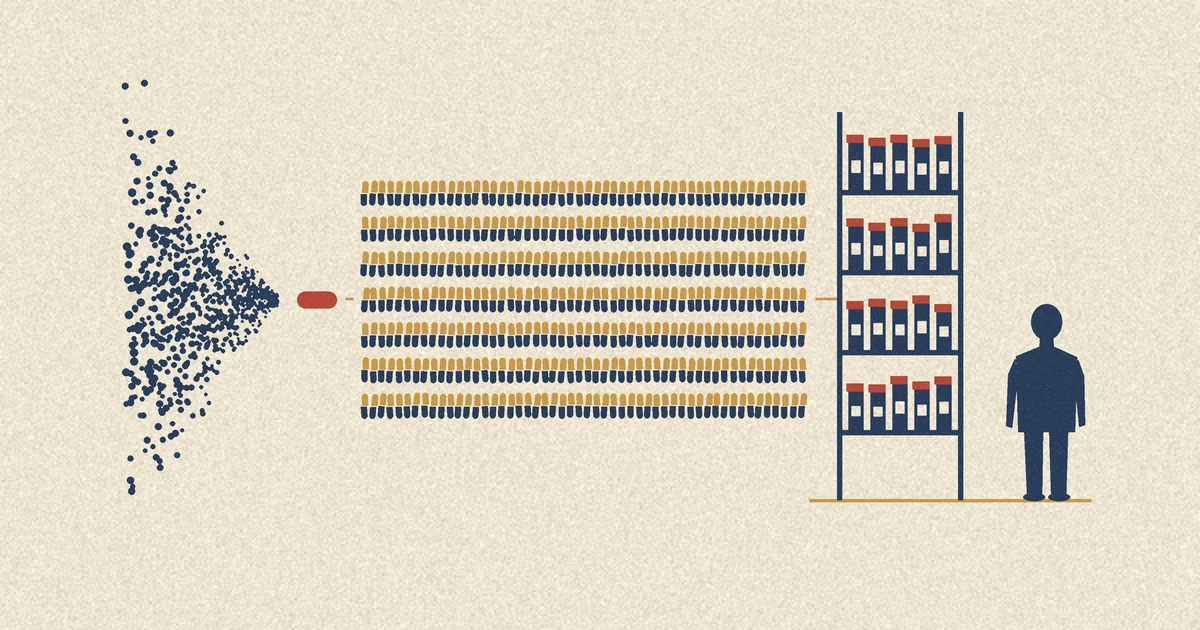
If I am going to write about what happens when AI speeds up medicine, I need to keep the steps straight. There are three of them. Finding a possible medicine. Proving it is safe and that it works. Getting it to the person who needs it. AI is changing those three steps at very different speeds.
Direct Answer
AI is making the first step faster. It is helping scientists figure out where to aim a medicine in the body and which chemicals might work, and it is doing in months what used to take years.[1][2][3]
Testing in people has not sped up the same way. The best-known medicine designed with AI from start to finish is a lung drug called rentosertib. Its large final study started in September 2026 and is not expected to finish until October 2029. It is not approved anywhere.[4][5]
The last step is one no computer fixes. In 2021, only about 1 in 5 U.S. adults with opioid addiction got a medication for it, and three medications that work already existed.[7][8] Faster discovery helps patients and families only if testing and access keep up.
Three steps, three speeds
Here is how I am using the words in this piece.
Finding a medicine means figuring out what in the body is causing the problem, and then finding a chemical that can fix it or block it. This happens on computers and in labs. It is where AI is moving fastest.
Testing means giving the possible medicine to people, first a few and then thousands, to see if it is safe and if it helps. The FDA says this usually happens in three rounds.[9] The first round uses 20 to 100 people and checks safety. The second uses up to several hundred people who have the disease and checks whether it works. The third uses 300 to 3,000 people and can take one to four years. Only about a quarter to a third of medicines that reach that third round move on to approval.[9]
Getting it to people means a doctor prescribes it, insurance or a program pays for it, and a clinic near you offers it. If you are on probation, in a treatment program, or locked up, it also means the system you are in lets you have it.
Someone who has never followed medical research will usually hear all three as one event. That is understandable, because the news often reports them that way. But a faster first step does not make the second and third steps faster on their own, and most of the waiting happens in those later steps.[9]
What AI has actually sped up
Start with proteins. Proteins are the tiny working parts inside our bodies, and a lot of diseases come from a protein doing something it shouldn’t. A protein’s shape decides much of what it does, and a medicine usually works by fitting against that shape.
For about fifty years, figuring out a protein’s shape was slow, hard work. In 2020, two researchers at Google DeepMind, Demis Hassabis and John Jumper, released an AI program called AlphaFold2 that predicts those shapes. It has now predicted the shape of almost every one of the roughly 200 million proteins scientists know about, and more than two million people in 190 countries have used it. They shared the 2024 Nobel Prize in Chemistry for it.[1] The other half of that prize went to David Baker, who designs brand new proteins on a computer, including ones that can be used as medicines and vaccines.[1]
Knowing a shape does not cure anybody. It gives scientists a place to start.
Antibiotics are another example. Some infections no longer respond to the antibiotics we have. In 2020, a research team taught an AI program to guess which chemicals would kill bacteria, and then had it look through more than 107 million of them on a computer.[2] It pointed them to one they named halicin. In mice, halicin cleared infections, including one from a kind of bacteria that resists the usual drugs.[2] That is a real result, but it was in mice, not people.
The clearest example is rentosertib. It is meant for idiopathic pulmonary fibrosis, a disease where scar tissue builds up in the lungs and breathing gets harder over time. The medicines doctors have now can slow it down, but they cannot undo it.[3][4]
A company called Insilico Medicine used AI to pick a new spot in the body to aim at, one the study’s lead doctor says had never been tied to lung scarring before. Then it used AI to design the chemical.[4] The company says it got from the start of the search to a medicine ready for animal testing in 18 months, and through its first small safety tests in people in under 30 months.[3]
Next came a small study. Seventy-one patients in China took rentosertib or a sugar pill for 12 weeks. On the highest dose, the amount of air people could blow out of their lungs went up a little on average. The sugar pill group lost a little.[3] Side effects were also more common on the real drug, mostly liver problems and diarrhea.[3] The researchers said the study was small and short, everyone in it came from one country, and bigger studies were needed.[3]
In How the Machines Actually Take the Work, I wrote that tools like AlphaFold could help medicine move from slowing diseases down toward curing ones we used to call incurable. I still think that is where the science is heading. This piece is about how many steps sit between a promising chemical and a medicine a person can actually take.
Testing in people is still slow
So where does the time go? Look at rentosertib.
About a year and a half to find it. About two and a half years to finish the first safety tests. Then a 12-week study with 71 people.[3]
Then, on September 9, 2026, the first patient started the big final study. It plans to include 320 people at 47 hospitals in China, and each of them will take the pill or a sugar pill for a full year.[4][5] It is expected to finish on October 30, 2029.[5] The lead doctor said that getting from the start of this study to approval would take three to four years if things go well.[4]
The computer work got shorter. The part where hundreds of people with a lung disease take a pill every day for a year, and doctors measure their breathing, did not.[4] That part can’t be skipped. It is how we find out whether a medicine helps or hurts.
The bigger picture looks the same. A 2024 study by researchers at Boston Consulting Group looked at medicines from companies that rely on AI. In the first round of testing, which checks safety, 21 out of 24 passed. That is better than usual.[6] In the second round, which checks whether the medicine actually helps sick people, 4 out of 10 passed. That is about the same as medicines found the old way.[6] The numbers are small, and the authors say so.
My plain reading is this. AI is good at picking chemicals that are safe enough to test. Whether one actually helps a sick person is still the hard part, and so far AI hasn’t changed that much. In 2025, the rentosertib researchers wrote that no AI-discovered drug had yet made it through the final round of testing.[3]
A medicine that exists still has to reach the person
This is the part I know from the inside. I think it is also the part that gets skipped.
In 2019, I relapsed while on probation. My agent’s answer was an alternative to revocation: eight months at the Milwaukee Secure Detention Facility (MSDF). In my memoir, I wrote, “I’d even requested the Vivitrol program, which had worked for me before.”[11] Vivitrol is a shot a nurse or doctor gives once a month. The FDA approved it to help people stay off alcohol, and to help prevent relapse to opioids after detox.[10] It had been found, tested, and approved years before I asked for it, and it had already worked for me once.
None of that decided whether I got it.
Would a newer, better version of that shot have changed what happened to me that day? I don’t think so. The decision was not about what medicine existed.
My case is one case, but the national numbers say it is not unusual. In 2021, about 2.5 million U.S. adults had opioid addiction. Only about a third got any treatment at all, and only about 1 in 5 got one of the three medications for it: buprenorphine, methadone, or naltrexone.[7][8] Black adults, women, people without jobs, and people living outside big cities were less likely to get medication.[7][8] That survey also leaves out people in jail or prison, so it can’t tell us how many get medication inside.[7]
Wilson Compton, the deputy director of the National Institute on Drug Abuse, said when the study came out that “safe and effective medicines to treat opioid use disorder are sitting on the shelf unused.”[8]
Years before I was writing about AI, I wrote in the memoir that someone who wants to quit should have every option, including “medication available, even to those with no means to pay.”[11] I am not a doctor or a scientist. I am someone who asked for a medicine that already existed and didn’t get it.
AI can make the list of possible medicines much longer. It can’t make a probation agent, an insurance company, or a clinic say yes.
What we need to get right
I don’t think the answer is to slow the science down. Faster discovery is good news, especially for families dealing with diseases that have no good treatment yet. What I think we need is to stop treating the first step as the finish line.
Read the headline for the step. When you see a story about an AI medical breakthrough, check which of these it is actually saying:
- a computer found or designed a possible medicine
- it worked in a lab dish or in animals
- it is being tested in people
- it is approved
- your insurance covers it and a clinic near you offers it
Each one is real progress, and each one is a different claim.
Put money and attention into testing. If AI keeps finding more possible medicines, we will need more hospitals running studies, more people willing to take part, and studies that include people from more places. The rentosertib researchers listed the fact that everyone in their study came from China, and were of similar race, as a weakness of their own study.[3]
Count success where the patient is. A medicine that was designed fast but that most patients can’t get has not helped most patients. I think the number to watch for any new medicine is how many of the people who have the disease end up getting it.
Don’t forget the medicines we already have. Some of them work and reach only a fraction of the people who need them.[7] A new AI-designed drug will not change that. Changing it is a choice about insurance coverage, doctors prescribing, and programs offering treatment, and we can make it right now.
Who owns the AI systems doing this work will also shape what these medicines cost. I wrote about that in Who Gets Rich When AI Does the Work?, and I am not going to repeat it here.
The step at the end
Some of this science is remarkable. Scientists can now look up the shape of almost any known protein. A company can design a medicine aimed at a spot in the body nobody had connected to the disease before.
None of that reaches a patient on its own. A medicine found in a year and a half still goes through years of testing in people. And a medicine that has been tested and approved still has to be offered to the person who asks for it. I asked for one and got eight months at MSDF instead.
If we speed up discovery and leave that last step alone, we will have more medicines and the same people going without them.
Frequently Asked Questions
Has AI already discovered a medicine people can buy?
Not one that was designed with AI from start to finish. Many drug companies now use AI somewhere along the way, so “AI-discovered” can mean different things. The best-known fully AI-designed drug, rentosertib, was still being tested and was not approved anywhere when its final study began in September 2026.[4][5]
Are AI-designed medicines more likely to work?
It is too early to say. One 2024 study found they passed early safety testing more often than usual, but passed the round that checks whether they help sick people at about the usual rate. The study only looked at a small number of medicines.[6]
What does AlphaFold do?
AlphaFold is an AI program that predicts the shape of proteins, the tiny working parts inside our bodies. A protein’s shape affects what it does and how a medicine might fit against it. Its creators shared the 2024 Nobel Prize in Chemistry.[1]
How long until an AI-designed medicine reaches patients?
For rentosertib, the final study started on September 9, 2026, and is expected to finish on October 30, 2029.[5] The lead doctor said approval would take three to four years from that start if things go well, and approval is not guaranteed.[4] Getting it to patients after approval is a separate step.
Is this medical advice?
No. This piece explains how new medicines get found, tested, and delivered. If you or someone you love needs treatment for substance use, talk with a health care provider, or call the free and confidential SAMHSA National Helpline at 1-800-662-4357 or visit FindTreatment.gov.[8]
How is this different from the earlier parts of the series?
Part 9 covered robots and machines doing physical work, including surgery. Part 8 covered who owns the machines. This part looks at finding, testing, and delivering medicines, and argues that AI is mostly speeding up the first one. The full list of parts is on the Artificial Intelligence & Society series page.
References
- The Royal Swedish Academy of Sciences. “The Nobel Prize in Chemistry 2024.” Press release, October 9, 2024. https://www.nobelprize.org/prizes/chemistry/2024/press-release/ Hassabis and Jumper for protein structure prediction with AlphaFold2 (2020), a problem researchers had worked on since the 1970s; structures predicted for virtually all 200 million proteins researchers have identified; used by more than two million people from 190 countries; Baker for computational protein design, including proteins usable as pharmaceuticals and vaccines.
- Stokes, J. M., et al. “A Deep Learning Approach to Antibiotic Discovery.” Cell 180, no. 4 (2020): 688-702. https://doi.org/10.1016/j.cell.2020.01.021 Deep neural network predicting antibacterial molecules; halicin found in the Drug Repurposing Hub, structurally divergent from conventional antibiotics, treated C. difficile and pan-resistant Acinetobacter baumannii infections in mice; more than 107 million ZINC15 molecules screened.
- Xu, Z., et al. “A generative AI-discovered TNIK inhibitor for idiopathic pulmonary fibrosis: a randomized phase 2a trial.” Nature Medicine (2025). https://www.nature.com/articles/s41591-025-03743-2 Phase 2a, 71 patients with IPF in China, 12 weeks; 60 mg once daily FVC +98.4 mL vs -20.3 mL placebo; treatment-related adverse events more common on rentosertib; discontinuations mostly liver toxicity or diarrhea; preclinical candidate in 18 months and phase 0/1 under 30 months from target discovery; limitations: small cohorts, short follow-up, participants all residents of China of similar race; no AI-discovered drug had progressed through phase 3; approved IPF drugs slow but do not reverse disease.
- Insilico Medicine. “Insilico Medicine Doses First Patient in GENESIS-IPF-3, the World’s First Phase III Trial of a Generative AI-Driven Innovative Drug.” Press release, September 10, 2026. https://insilico.com/news/isn1009261-insilico-medicine-doses-first-patient-genesis-ipf-3 First patient dosed in Phase III GENESIS-IPF-3; 320 participants, 47 centers in China, 52 weeks; lead investigator: TNIK had never previously been linked to fibrosis, and three to four years from Phase III start to approval under favorable conditions; drug remains investigational and not approved by any regulatory authority.
- ClinicalTrials.gov. “Study Evaluation Rentosertib (INS018_055) Administered Orally in Patients With Idiopathic Pulmonary Fibrosis (IPF).” NCT07687459. https://clinicaltrials.gov/study/NCT07687459 Actual start September 9, 2026; estimated primary and study completion October 30, 2029; estimated enrollment 320; recruiting.
- Jayatunga, M. K. P., et al. “How successful are AI-discovered drugs in clinical trials? A first analysis and emerging lessons.” Drug Discovery Today 29, no. 6 (2024): 104009. https://doi.org/10.1016/j.drudis.2024.104009 Boston Consulting Group authors; 21 of 24 AI-discovered molecules that completed Phase 1 succeeded (80 to 90 percent); four of 10 that completed Phase 2 succeeded (about 40 percent), in line with historical industry averages of 30 to 40 percent; limited sample size.
- Jones, C. M., et al. “Use of Medication for Opioid Use Disorder Among Adults With Past-Year Opioid Use Disorder in the US, 2021.” JAMA Network Open 6, no. 8 (2023): e2327488. https://doi.org/10.1001/jamanetworkopen.2023.27488 2021 NSDUH: an estimated 2.5 million adults with past-year opioid use disorder; 35.6 percent received any substance use treatment and 22.3 percent received medication; Black adults, women, unemployed adults, and nonmetropolitan residents less likely to receive it; survey excludes incarcerated people.
- National Institute on Drug Abuse. “Only 1 in 5 U.S. adults with opioid use disorder received medications to treat it in 2021.” News release, August 7, 2023. https://nida.nih.gov/news-events/news-releases/2023/08/only-1-in-5-us-adults-with-opioid-use-disorder-received-medications-to-treat-it-in-2021 Buprenorphine, methadone, and naltrexone underused; Wilson Compton quote; National Helpline 1-800-662-HELP (4357) and FindTreatment.gov.
- U.S. Food and Drug Administration. “Step 3: Clinical Research.” https://www.fda.gov/patients/drug-development-process/step-3-clinical-research Phase 1: 20 to 100 people, several months, safety and dosage, about 70 percent move on; Phase 2: up to several hundred people, several months to 2 years, efficacy and side effects, about 33 percent move on; Phase 3: 300 to 3,000 people, 1 to 4 years, about 25 to 30 percent move on.
- U.S. Food and Drug Administration. VIVITROL (naltrexone for extended-release injectable suspension) prescribing information, 2010. https://www.accessdata.fda.gov/drugsatfda_docs/label/2010/021897s015lbl.pdf Indicated for alcohol dependence and for prevention of relapse to opioid dependence following opioid detoxification; injection every 4 weeks or once a month administered by a healthcare professional.
- Drasen, Andrew. A Vision of Hope. Memoir. https://www.avisionofhopebook.com/books/memoir “It’s MSDF or revocation of your probation”; “I’d even requested the Vivitrol program, which had worked for me before”; eight months for a relapse; “medication available, even to those with no means to pay.”