
Table of contents
ARTIFICIAL INTELLIGENCE & SOCIETY
PART 13
Imagine we are past required work, and the days are free to do with as we please.
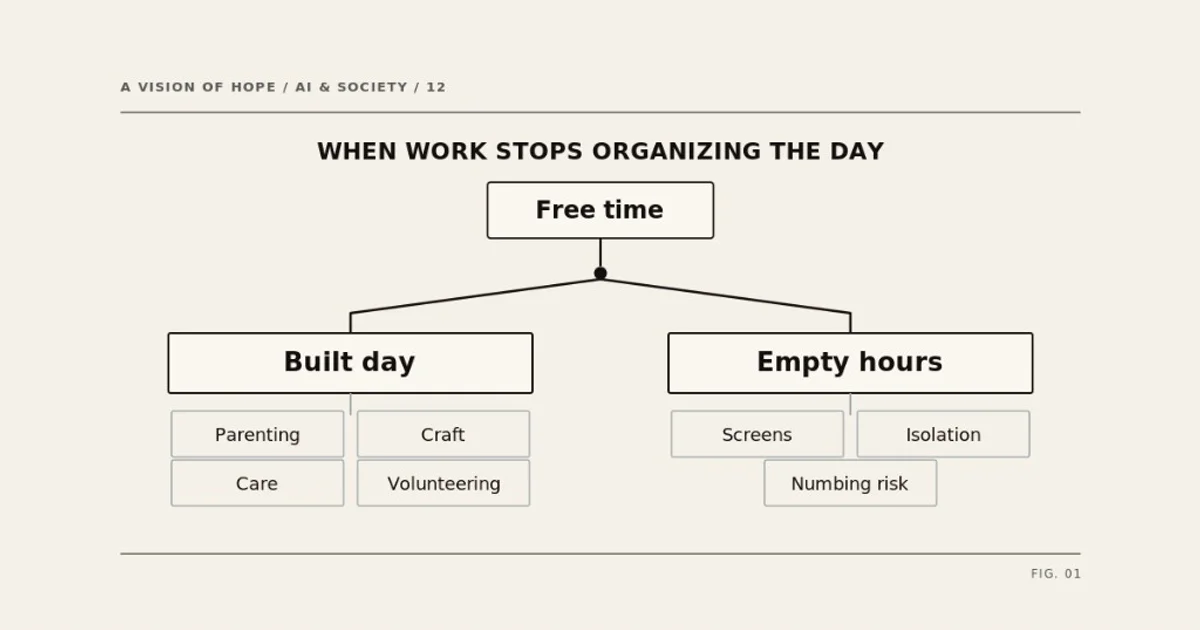
One man plays catch with his kids. There is nowhere he has to be by 8:00, no badge to swipe, and no manager who notices if he doesn’t show. Later he paints for an hour because the canvas is still unfinished. He practices guitar until his fingers hurt. He digs in the garden. In the afternoon he walks to the grocery store. Nobody stocks the shelves by hand anymore. The store still smells like cold air and cardboard. On the way home he passes someone on the sidewalk who is clearly high.
Same free day. Different life.
The second man didn’t wake up wanting to destroy himself. For a long time a job told him when to get up, who needed him, and what to say when somebody asked what he did. When that structure went away, the hours didn’t fill with purpose on their own. They filled with whatever took the edge off. Screens. Substances. Anything that made the empty stretch feel shorter.
Those are two ways a free day can go.
In What If Most of Us Don’t Have to Work Anymore?, I argued that a future with far less required work could expand freedom if we share the gains and take empty time seriously. In Who Gets Rich When AI Does the Work?, I argued that a monthly survival check isn’t the same thing as owning a stake in the machines. This essay doesn’t reopen those fights. It asks the question those pieces left open.
When work is optional, what gives a life weight?
What a job was carrying
For most of modern life, a job has been more than income.
A job told you when the day started and put you around other people. It handed you problems you didn’t invent that morning. It gave status, or at least a title you could use at a reunion. It answered the small-talk question that is also a ranking question: what do you do?
None of that is fake. People aren’t shallow for caring about it.
A scoping review on meaning in the retirement transition notes that work is an important source of meaning for many people, and that leaving paid work can challenge roles, identity, and purpose.[1] Another review of mental health in the move from work to retirement lists protective factors that sound ordinary because they are ordinary: social participation, volunteering, relationships, optimism, and keeping a sense of purpose and identity. The risk list is ordinary too: involuntary or poorly planned exit, loneliness, isolation, and the loss of a work-related self.[2]
Retirement isn’t a post-work civilization. It’s the closest large natural experiment we have for what happens when paid work stops organizing the week while the person is still alive and still needs a reason to get out of bed.
If AI and robotics eventually make most survival labor optional, that experiment stops being a late-life chapter and becomes a society-wide condition. Keep fighting about money and ownership. Also ask what replaces that structure when a paycheck stops telling people when to get up.
One path: a day you build
Go back to the first man on that walk.
His day was full of things a payroll never really paid for: parenting, craft, practice, growing food, being outside, being needed by a child who wanted to throw a ball. That isn’t a utopia where everyone becomes a painter. Meaning has always lived in more places than an employer could see.
Contribution without a paycheck keeps showing up in the research. Reviews of volunteering find associations with wellbeing, life satisfaction, and lower depression in cohort studies, and qualitative work keeps pointing to the same pathways: social connectedness, self-efficacy, and a sense of purpose.[3][4][5] That doesn’t make volunteering a cure. Some reviews are low quality, and experiments don’t always line up with what the cohorts suggest. Even with those limits, being useful to someone else is one of the most reliable ways people feel like their life is about more than their own appetite.
Making things can do that too, and so can learning, and so can taking care of someone. A novel nobody has bought yet still asks something of you, and an instrument still rewards the hour you gave it. Sitting with an aging parent isn’t leisure. It’s work our economy often fails to recognize.
Family can sit at the center of a free day, and a job never really paid for that part. Machines can take the shifts. Kids still only get one childhood, and adults still have to show up with attention left for them.
The other path: empty time
Now the man on the sidewalk.
Free time doesn’t cause addiction by itself.
Unemployment is associated with higher rates of substance use disorders, and the relationship runs both ways: losing work can worsen substance problems, and substance problems can make steady work harder to keep.[6] A broader narrative update finds unemployment associated with worse mental wellbeing and with several psychiatric disorders, with especially strong links for depression and substance use. Long-term unemployment looks particularly hard.[7] Research on retirement and substance use in older adults is mixed on whether drinking reliably rises. Risk factors keep appearing anyway: involuntary retirement, high stress in the job before exit, sleep problems afterward, and in some studies a pattern of drinking more on the occasions when people do drink.[8]
That doesn’t mean every person without a job will get high. It means when structure, income stress, identity, and sleep break at the same time, numbing becomes an available answer. Screens can fill empty hours the same way, and so can gambling, and so can anything that compresses time you don’t know how to fill.
In a world where survival no longer requires showing up, the people most at risk aren’t the ones who suddenly have hobbies. They’re the ones whose only reliable structure was the necessity of being somewhere at a certain hour for people who expected them.
Remove the necessity without replacing the being-needed, and some people won’t spontaneously become gardeners. They’ll look for relief.
Who are you when the title leaves?
There is another hole under the schedule hole.
For a lot of people, the job wasn’t just what they did. It was who they were allowed to be in public. When that role ends involuntarily, research on career change describes a kind of identity loss: a gap between the self you had at work and the self you’re stuck with now, then a messy middle where the old story no longer fits and the new one isn’t built yet.[9]
You see versions of this after layoffs, after forced retirement, and in recovery rooms. Somebody loses the badge and discovers the badge was doing more emotional labor than they admitted. The question “what do you do?” used to come with an answer. Now it comes with a silence, and silence is uncomfortable enough that people invent ways not to hear it.
A society that makes work optional will either help people build identities that aren’t rented from employers, or it will watch status collapse into whatever can still be performed on a social media feed.
Meaning isn’t one thing
Faith can carry it for some people: a congregation, or the sense that a life is answerable to something larger than a quarterly target. Others will find it in secular service, art, science for its own sake, or becoming a better parent than the one they had. The body can carry it too through sport, training, or walking until the mind quiets. So can friendship that isn’t networked through a workplace.
Meaning tends to involve at least one of these: being needed, becoming capable, belonging to people who would notice if you disappeared, or answering to a standard you didn’t invent this morning. A job can deliver all four by accident. Optional work doesn’t. Optional work only delivers time.
What has to catch people when workplaces don’t
If the first path is personal, the second path is also institutional.
Schools that only train people for jobs will look strange in a world with fewer jobs. They’ll need to teach people how to learn for decades, how to cooperate, and how to sit with boredom without surrendering to the most addictive product in the room.
Faith communities, civic clubs, mutual aid groups, recovery meetings, libraries, maker spaces, sports leagues, and neighborhood associations aren’t decorations on top of an economy. In a low-compulsory-work world they become some of the only reliable places where a person is expected, missed, and asked to contribute.
People already in the hole still need treatment systems. If empty time rises and we answer only with cheaper entertainment and weaker connection, we shouldn’t act surprised when more people need a way out of numbing.
None of that replaces the distribution fight in Parts 7 and 8. A person can’t build a meaningful free day on hunger and eviction. Survival is the floor. Purpose is what you do with the hours above the floor.
How we keep free time from becoming empty time
I don’t think the answer is a slogan about passion.
Most durable meaning looks more like commitment: a practice you return to when you don’t feel inspired, a person who needs you on the days you’d rather disappear, and a community that assigns you a role before you feel ready for one.
Practically, that means a few things we can start before any post-work forecast comes true.
Build sources of being-needed that don’t depend on a boss: mentorship, care, volunteering that is real work rather than résumé decoration, or a craft with a standard you can fail.
Practice structure on purpose with wake times, training, creative hours, and shared meals. The calendar doesn’t have to be an employer’s calendar to still be a calendar.
Talk honestly about status. If your whole self-worth is a LinkedIn headline, optional work will feel like erasure even if the money arrives. Diversify the places you can be proud without performing productivity for capital.
Fund and join the institutions that hold people when they wobble. That is civilization maintenance, not optional charity.
And tell the truth about escape. Numbing is understandable, and it’s also a trap. The people on the sidewalk aren’t a different species from the people in the yard. They’re often what happens when structure leaves and nothing loving replaces it.
Back to the sidewalk
I don’t know which future we get.
I know the technology won’t decide it for us. The same automation that frees a man to play catch with his kids can leave another adult with a day that has no one in it and no reason to stay sober through the afternoon.
The fork is practical. Either we treat purpose as something a job used to supply by default, and we rebuild it on purpose, or we confuse free time with a life and then act shocked when empty hours look for something that hurts less than silence.
Free time isn’t automatically a life. Purpose has to be rebuilt on purpose.
Frequently Asked Questions
Is this saying AI has already made work optional?
No. The opening scenes are labeled as a hypothetical. Current evidence still points to transformation and mixed job effects more than a settled end of work. The purpose question is worth asking before a society-wide version arrives, because retirement and unemployment already show what happens when work structure fails for some people.[1][2][6][7]
Are you saying people without jobs will become addicted?
No. Unemployment and substance use are associated, and the arrow can point both ways. Retirement research on alcohol is mixed. The claim here is narrower: when structure, identity, and being-needed collapse together, numbing becomes a more available answer for some people. That is a risk to prepare for, not a destiny to assign.[5][6][7][8]
Isn’t this just telling people to volunteer and find a hobby?
No. Volunteering and craft show up because the evidence and ordinary life both keep pointing there, but they are examples of being useful and becoming capable, not a complete checklist. Family, care, faith, friendship, learning, and recovery work can fill that need too. Institutions have to make those paths easier, not dump the whole problem on individual grit.[3][4][5]
How is this different from the earlier post-work essays?
Part 7 asked whether optional work could expand freedom and named empty time as a danger. Part 8 asked who owns the machines. This piece asks what meaning is when a job no longer assigns it, and what personal and institutional structure has to replace the workplace as the default organizer of adult life.
Do I need religion for meaning if work fades?
No. Some people will. Some won’t. This essay leaves room for faith without requiring it. The shared claim is that meaning usually involves being needed, belonging, growth, or answering to a standard larger than a morning mood, and that those things can be secular or sacred.
References
[1] Wood, R. E., and N. A. Pachana. “The Role of Meaning in the Retirement Transition: Scoping Review.” The Gerontologist 65, no. 6 (2025): gnaf076. https://academic.oup.com/gerontologist/article/65/6/gnaf076/8023525
[2] “Analysis of factors that influence mental health in the transition to retirement: scoping review.” BMC Public Health (2026). https://link.springer.com/article/10.1186/s12889-026-28628-y
[3] Nichol, B., et al. “Exploring the Effects of Volunteering on the Social, Mental, and Physical Health and Well-being of Volunteers: An Umbrella Review.” VOLUNTAS (2023). https://link.springer.com/article/10.1007/s11266-023-00573-z
[4] Jenkinson, C. E., et al. “Is volunteering a public health intervention? A systematic review and meta-analysis of the health and survival of volunteers.” BMC Public Health 13 (2013): 773. https://link.springer.com/article/10.1186/1471-2458-13-773
[5] What Works Centre for Wellbeing / Institute for Volunteering Research. “The Impacts of Volunteering on the Subjective Wellbeing of Volunteers: A Rapid Evidence Assessment.” 2020. https://whatworkswellbeing.org/wp-content/uploads/2020/10/Volunteer-wellbeing-technical-report-Oct2020-a.pdf
[6] “Unemployment and Substance Use: An Updated Review of Studies from North America and Europe.” Healthcare 11, no. 8 (2023): 1182. https://www.mdpi.com/2227-9032/11/8/1182
[7] “Association Between Unemployment and Mental Disorders: A Narrative Update of the Literature.” International Journal of Environmental Research and Public Health 21, no. 12 (2024): 1698. https://www.mdpi.com/1660-4601/21/12/1698
[8] Update and expansion on retirement and older adults’ substance use. The American Journal of Geriatric Psychiatry (2021). https://www.ajgponline.org/article/S1064-7481(21)00120-2/abstract
[9] Brazier, C., et al. “Navigating Involuntary Career Changes: Emotional Dynamics During Work-Related Identity Loss and Recovery.” 2025. https://orbi.uliege.be/bitstream/2268/336728/1/brazier-et-al-2025-navigating-involuntary-career-changes-emotional-dynamics-during-work-related-identity-loss-and.pdf