
Table of contents
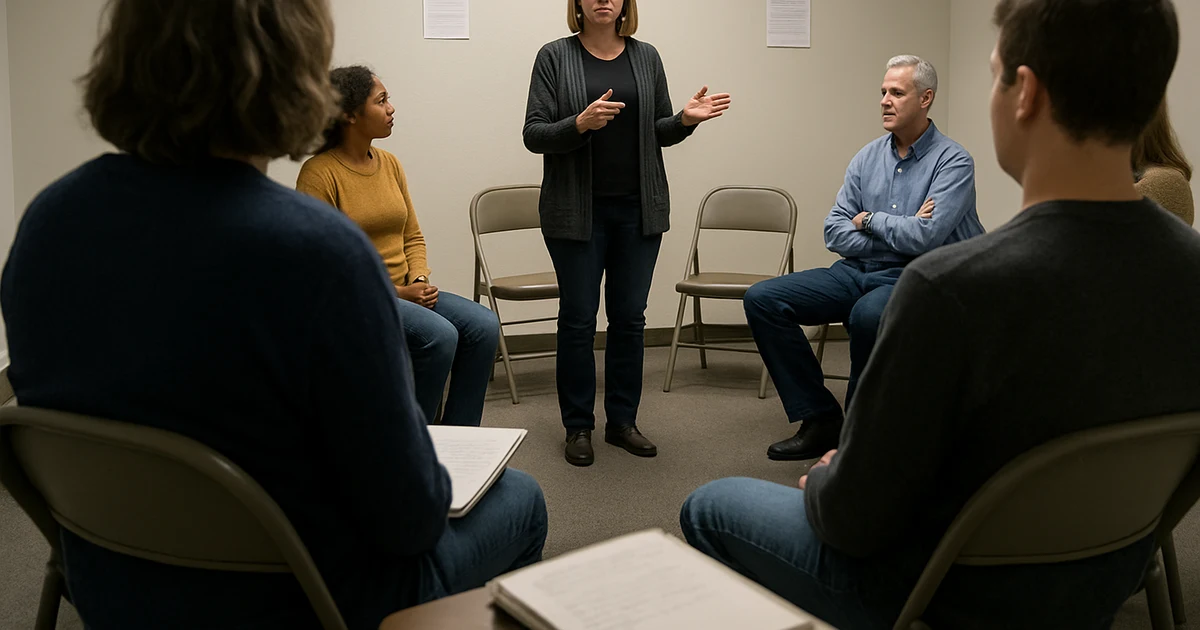
Here is a bereavement circle that is supposed to help. Ten chairs. A facilitator who means well. One member starts talking about the empty side of the bed, and another member jumps in with what worked for them, what the deceased would have wanted, or which stage of grief everyone is “in.” A third member goes quiet and never comes back.
That room did not fail because people cared too little. It failed because the container was wrong. I want to talk about structured grief group facilitation as the craft of holding that room without turning it into a lecture, a stages checklist, or amateur therapy. An agenda can look polished on paper and still fail the people in the chairs. What I look at is whether a grieving person can speak without being fixed, interrupted, or forced.
Direct Answer
Structured grief group facilitation means the facilitator holds clear agreements and a workable session rhythm so people can share without being fixed, interrupted, or forced. In ReturnPath’s Grief & Bereavement model, most of the deep work happens between sessions through reading and writing, and group time processes what that independent work already brought up. The curriculum complements licensed grief therapy. It does not replace clinical care.
What “structured” actually means
People hear “structure” and expect a binder full of scripts, or a facilitator who talks for forty minutes. That is not what I mean.
Structure is the difference between a room that can hold pain and a room that dumps people into open venting with no edges. It is also the difference between a shared agreement and a free-for-all where the loudest voice, or the most helpful advice-giver, runs the night. When that happens, quieter people learn the cost of honesty fast. But they often keep showing up anyway, just quieter about what hurts.
There is a workable pattern underneath most solid bereavement groups. First, the room knows why it exists. Peer support is not the same job as licensed grief counseling, and pretending otherwise puts everyone at risk.[1] Second, the group has agreements people can remember under stress: confidentiality with real limits, speaking from your own experience, and the freedom to pass. Third, there is a beginning, middle, and end so the meeting does not spill into the parking lot as raw exposure with nowhere to land.[1][2][3]
Those pieces are ordinary facilitation craft. Plenty of bereavement guidance already names them. The harder part is the purpose behind the craft. Structure that only delivers content becomes a lecture. Structure that only opens the floor with no container becomes advice and comparison. Structure that exists to move people through stages on schedule becomes performance. Structured grief group facilitation should serve safety and honest processing, not a tidy finish line.
Structure is not a lecture, and it is not therapy
This is the clarification that keeps getting blurred.
A lecture tells people what grief is supposed to look like. A processing session helps people work with what already showed up in their week: the anger that came during dishwashing, the guilt after a good day, the identity question that will not leave them alone. The facilitator holds time, redirects advice, protects quieter members, and refuses to clinically interpret someone else’s story. That is facilitation. It is not a treatment hour.
Bereavement support group guidelines are blunt about the facilitator role: do not preach, and do not prescribe a “right way” to grieve.[2] Practitioner guides make the same point from the other direction. A grief support group is a peer-based space for sharing and support, not therapy, and grief support group facilitation is structure and safety rather than fixing people.[1][3]
The boundary is practical, not theoretical.
Program directors run into the same boundary. You can license curriculum, train facilitators, and run an honest group without claiming your team is delivering clinical bereavement therapy. A participant who needs clinical care needs referral, not a braver group conversation. When programs blur those jobs, participants can walk out thinking they already got therapy when they only got peer support. The harm is quiet, and it shows up later, when the person still needs clinical care and never went. But the room may still look successful on the attendance sheet.
So facilitators should name that boundary out loud, in plain words.
Co-facilitation is often advised for related reasons. When one member becomes overwhelmed, a second facilitator can step out with them as the group continues.[2]
Guardrails that keep sharing safe
The agreements are what protect people in the room. How to facilitate a grief support group without turning it into therapy starts here, with rules people can remember when a meeting gets hard:
- Voluntary disclosure
- No cross-talk
- No unsolicited advice
- Confidentiality with honest limits
Voluntary disclosure. Nobody owes the room their worst details to prove they belong. Participants choose what to share and what to keep in private writing. Silence is allowed. Passing is allowed. If a group requires trauma disclosure to “get real,” that is not trauma-informed facilitation. That is pressure with spiritual language taped over it. I think facilitators underestimate how fast forced disclosure teaches people to perform instead of tell the truth.
No cross-talk. Cross-talk sounds small until you watch it land. One person is still finding the words, and another jumps in with a related story, a correction, or a question that hijacks the moment. The first speaker learns the room cannot hold a full thought. Over time, people stop bringing the real thing. That leaves the group looking honest as it becomes safer for surface talk. The rule exists so a grieving person can finish a full thought before anyone else speaks.
No unsolicited advice. Advice is how people try to be useful when pain makes them helpless. It usually lands as judgment. Bereavement facilitation guides treat “no unsolicited advice” as a core agreement for that reason.[1][3] Speak from your own experience if you speak at all. Do not fix, rescue, or correct someone mid-grief.
Confidentiality belongs here too, with honest limits. What is shared in the room stays in the room, except when safety or safeguarding requires otherwise.[2] Vague confidentiality promises are worse than clear ones. People share under a false sense of privacy.
Put those agreements on the wall if you need to. Better: put them in the facilitator’s mouth at the start of every meeting until the room can hold them without being reminded. When advice starts, stop it. When someone dominates, redirect. When a participant goes quiet after being interrupted, repair it before the night ends. That is structured grief group facilitation in the room. Not a vibe. A set of decisions.
But none of it works if the facilitator will not enforce the agreements when they get inconvenient.
Open groups can welcome people whenever they show up. Closed groups keep the same members for a set stretch so trust can deepen. Both can be structured. Neither is safe by default. An open group still needs agreements and endings. A closed group still needs voluntary disclosure and a ban on advice culture. Format does not replace facilitation. I think that is the line programs forget when they buy a binder and skip the room craft.
Independent writing between sessions, processing in the room
Here is where ReturnPath’s model gets specific, and where a lot of “grief group tips” lists go thin.
Most of the work is independent. Participants read and write between contact. Then the facilitated session processes what that work surfaced. The group is not inventing the deepest material on the spot under fluorescent lights with ten strangers watching. People arrive already carrying something, and they choose what to bring forward. That order is safer for members, because private writing lets a member go further than they are ready to say aloud. Group time stays about voluntary sharing rather than forced excavation.
When the writing is already underway, the facilitator does not have to manufacture intensity with a clever prompt every week. The curriculum already gave people something real to work. The ordinary result is a quieter room with more substance. The pressure to perform grief on demand goes down. For me, that is one of the cleanest safety features in a grief curriculum: depth without forced excavation in front of strangers.
The Workbook carries daily practice. Reflections and the Memoir carry narrative and values work across the arc. The point of naming those books here is not product stacking. It is the mechanism: reading and writing feed the room, and the room processes what people choose to share.
Groups with no independent work at all can still run honest peer support with strong agreements. Depth without turning every session into a crisis dump or a lecture often needs independent work between contact. That remains one of the cleanest structures available. That is why the session feels different when people show up already mid-thought.
Identity work after loss without forced closure
Catastrophic loss is not only sadness. It rearranges identity. Who am I without this spouse, this marriage, this health, this future I was building? A stages checklist can name common reactions and still miss that question entirely.
Meaning-reconstruction scholarship treats grieving, in part, as rebuilding a sense of meaning, identity, and worldview after the old story no longer fits.[4] That research frame is useful. It refuses the fantasy that grief is a checklist you finish. Feasibility work on meaning-based bereavement groups also shows that structured meaning work in group settings can be studied carefully without turning every support circle into an outcome brochure.[5]
Perhaps the cleanest way to say it is this: people are not only mourning what happened. They are trying to live as the person they are becoming after it happened.
ReturnPath uses that identity lens educationally. Participants rebuild who they are becoming while carrying love and pain forward, without forced closure and without pretending the loss is “resolved” because week fourteen arrived. The published grief guide walks that curriculum packaging in more detail. This essay stays on facilitation practice.[6]
One note on origin. ReturnPath’s Grief & Bereavement track grew from Caroline’s death by suicide and the identity collapse that followed. That story is already told on the grief track and in the essay about the three events that shaped my life. I am not inventing new scenes for this page. I am naming why the curriculum refuses tidy stages as the main model.
When a facilitator treats stages like a scoreboard, the room learns to perform progress instead of telling the truth about what still hurts. But forced progress is not healing. That is why I keep the facilitation conversation here, and leave the deeper meaning-reconstruction essay for its own page.
How ReturnPath’s Grief & Bereavement track holds this model
Facilitators running hospice follow-up, a healing circle, a faith community grief group, or a counselor-supported bereavement program, the Grief & Bereavement track is the public home for this model. The published guide, What Grief Support Curriculum Works for Bereavement Groups and Healing Circles?, covers the curriculum arc for program directors. What this article adds is the facilitation claim in plain language.
ReturnPath runs a 16-week facilitator-led arc: Memoir weeks for narrative identity and loss context, Reflections weeks for values and reframing after loss, and Workbook weeks for daily accountability and capstone. Delivery can flex across closed cohorts, rolling enrollment, hybrid formats, and other adaptations named on the curriculum hub. Facilitators hold voluntary disclosure, no cross-talk, and no unsolicited advice. Sessions process what independent work surfaced. They are not lectures and not therapy hours.
ReturnPath is evidence-informed curriculum at the identity and facilitation layer. It does not claim SAMHSA registry listing or third-party EBP validation. Licensed clinicians keep clinical protocols. The curriculum adds structured reading, writing, and group processing beside that care.
I will not move that line for any program.
If a program needs clinical bereavement therapy, hire clinicians for clinical bereavement therapy. If a program needs structured identity curriculum with safe group processing, look at ReturnPath. Those are related jobs. They are not the same job. In the end, the curriculum only works if the facilitation holds. When the agreements fail, the curriculum becomes another binder on a shelf.
What this model is not
It is not a stages-of-grief performance script. Stages language can help some people name feelings. It becomes harmful when facilitators use it as a scoreboard.
It is not the trademarked Grief Recovery Method, and this essay does not borrow that system’s language or protocols.
It is not a promise that every participant will feel better by a certain week, or that your program will publish outcome percentages you cannot defend.
It is not a second grief curriculum pillar. The spoke already exists. The Aug 8 guide already packages the track. This page owns facilitation depth so facilitators can tell a held room from an advice circle.
It is not permission to invent clinical authority. An unlicensed facilitator should not market the group as grief therapy.
Closing
Before the next bereavement meeting, look at the room you are about to hold. Do people know they can pass? Does advice get stopped, or rewarded? Is the facilitator teaching a lecture, or processing what already surfaced? Is anyone being pushed to disclose more than they chose?
Sometimes the answer is one small repair: stop the advice earlier, name the pass option again, or end on time so people are not left raw in the hallway. Adjusting one agreement from those questions this week already shows the structure is doing its job. When the room gets honest again after that repair, keep the agreement.
But do not wait for a crisis to remember why the guardrails exist.
Directors who need a curriculum spine that matches this facilitation model, start with the Grief & Bereavement track and the published grief curriculum guide. Hold the room. Leave clinical care to clinical care. Let people become who they are becoming after loss without forcing the ending.
Frequently Asked Questions
What is structured grief group facilitation?
Structured grief group facilitation holds a bereavement or healing-circle room with clear agreements and a session rhythm so people can share safely. In ReturnPath, structure also includes independent reading and writing between sessions, with group time used to process what already surfaced.
How do you facilitate a grief support group without turning it into therapy?
Name the boundary out loud. Use agreements that ban unsolicited advice and forced disclosure. Hold time and redirect the room instead of interpreting a member’s grief clinically. Refer people who need clinical care to licensed clinicians.[1][2][3]
What ground rules matter most in a bereavement group?
Voluntary disclosure, no cross-talk, no unsolicited advice, and confidentiality with clear limits. Those agreements protect quieter members and stop advice culture from taking over.[1][2][3]
How is ReturnPath different from an open discussion grief circle?
ReturnPath adds a curriculum spine and independent work between contact. Facilitated sessions process what reading and writing brought up, rather than inventing the deepest material only in the room. Agreements still apply either way.
Does ReturnPath replace licensed grief therapy?
No. ReturnPath complements licensed grief therapy and clinical protocols. It does not replace them, and it does not claim SAMHSA registry listing or third-party EBP validation.
Do participants have to share trauma details in group?
No. Sharing stays voluntary. Participants can keep deeper material in private writing and bring only what they choose into the room.
References
-
The Loss Foundation. How to Run a Grief Support Group: A Step-by-Step Guide for New Facilitators. January 15, 2025. https://thelossfoundation.org/how-to-run-a-grief-support-group-a-step-by-step-guide-for-new-facilitators/
-
National Bereavement Alliance / Childhood Bereavement Network / SASP. Guidelines for delivering bereavement support groups. 2019. https://nationalbereavementalliance.org.uk/wp-content/uploads/2019/11/SASP-NBA-Guidelines-booklet.pdf
-
Heather Stang. How to Lead a Grief Support Group. https://heatherstang.com/lead-grief-support-group/
-
Neimeyer, R. A. (2016). Meaning reconstruction in the wake of loss: Evolution of a research program. Behaviour Change, 33(2), 65-79. https://doi.org/10.1017/bec.2016.4
-
MacKinnon, C. J., et al. (2015). Reconstructing meaning with others in loss: A feasibility pilot randomized controlled trial of a bereavement group. Death Studies. https://doi.org/10.1080/07481187.2014.958628
-
Drasen, A. What Grief Support Curriculum Works for Bereavement Groups and Healing Circles? A Vision of Hope Media. https://www.avisionofhopebook.com/insights/purpose-identity/grief-bereavement-curriculum