
Table of contents
If you are a program director, clinical supervisor, or certified peer recovery specialist searching for a substance abuse treatment curriculum that fits intensive outpatient (IOP), PHP, sober living, or peer support settings, you are usually asking a practical question: what can my team run between facilitated sessions that builds identity and daily accountability through structured reading, writing, and processing?
Andrew Drasen built ReturnPath from lived experience across addiction, incarceration, and recovery program design. This page explains how the Recovery & Peer Support track fits IOP and sober living as a facilitator-led curriculum you can license and adapt. It is not a clinical replacement. There is still a clinical stack to protect. ReturnPath is the identity layer that can sit beside the methodology you already run.
Direct Answer
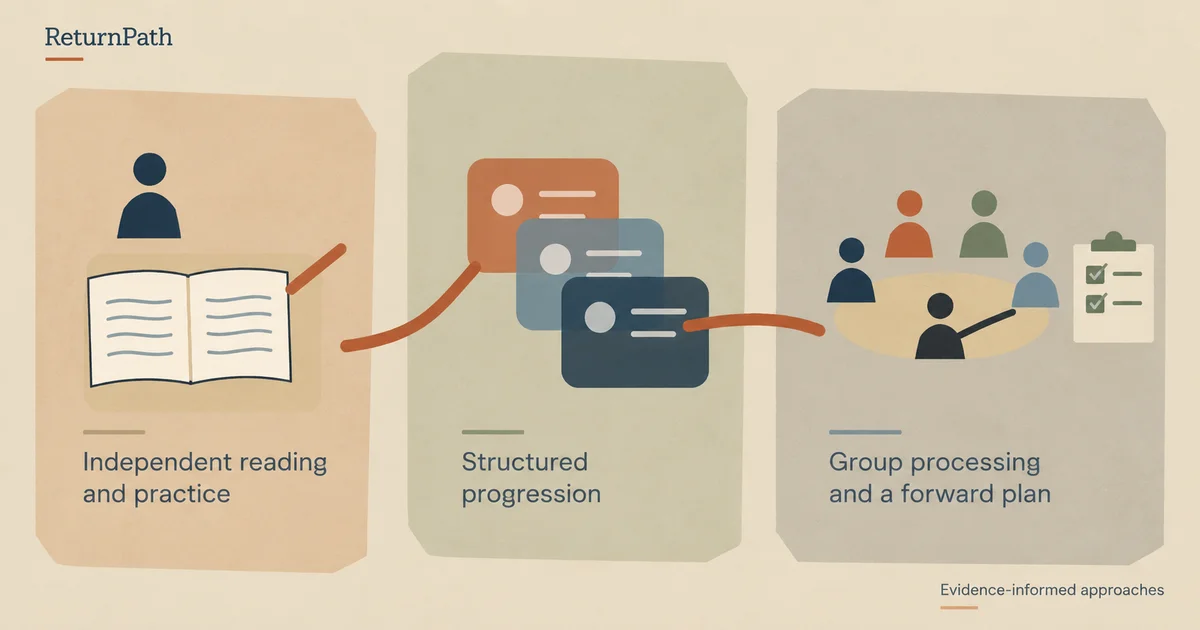
There is a practical test for IOP substance abuse curriculum: can staff name the goals, point to a Phase 2 values and identity stretch inside a 16-week arc, and show process outcomes without inventing success claims? ReturnPath Recovery & Peer Support answers that test through three phases: Phase 1, weeks 1–7, memoir as narrative mirror. Phase 2, weeks 8–11, Reflections for values clarification and identity-level cognitive reframing. Phase 3, weeks 12–16, Workbook accountability and capstone planning. Participants do nightly reading and daily workbook writing on their own. Facilitated sessions process what that work surfaced. In practice, staff and participants should be able to show completed daily Workbook practice, Phase 2 values and identity writing, capstone materials, and staff-visible accountability between IOP blocks. ReturnPath fuses narrative identity, MI principles, cognitive reframing, trauma-informed facilitation, and peer accountability. It complements existing IOP methodology rather than replacing clinical protocols.
What goals does an IOP substance abuse curriculum need to hit?
There is a familiar gap when directors evaluate curriculum packs. The brochure sounds complete, but the hours between sessions stay empty. If you map goals to mechanisms, not slogans, the pack either holds or evaporates. ReturnPath Recovery & Peer Support was built around seven goals already implied by the look-fors below.
-
Independent work between contact. Most recovery happens between sessions. Nightly reading and daily Workbook prompts structure the hardest hours so facilitated sessions process work already done.
-
Identity-based recovery, not a symptom checklist. Behavior change sticks when participants articulate who they are becoming. ReturnPath places identity at the center of Phase 1 memoir work and carries that layer through Phase 2 values work and Phase 3 capstone planning.
-
A named Phase 2 values and identity stretch. Weeks 8–11 use Reflections for values clarification, trigger mapping, and belief-level reframing: self-acceptance, forgiveness, resistance, inner dialogue before action planning intensifies.
-
Therapeutic fusion that peers can run. Narrative identity, MI principles, cognitive reframing, expressive writing, trauma-informed facilitation, peer accountability, and capstone action planning need facilitator guides that do not require clinical licensure at every touchpoint.
-
Peer support and CPRS fit. CPRS coordinators and peer specialists need session structure they can hold in groups, house meetings, and one-on-one mentoring.
-
Flexible cadence for IOP, PHP, and sober living. Format and session length are program-defined. The curriculum sequence and facilitator boundaries stay intact while delivery fits existing blocks.
-
A clear 16-week arc with process outcomes. Clinical notes, treatment plans, and pilot evaluation need a measurable progression and artifacts staff can show. That does not mean inventing success claims.
These goals are design requirements. They are not outcome claims.
But without them, a curriculum often collapses into group time that never touches the hours that decide whether someone can hold the next day. As a result, staff inherit another binder and still lack a Phase 2 values stretch they can name.
What modules make up the 16-week ReturnPath IOP arc?
ReturnPath Recovery & Peer Support runs a 16-week arc in three phases. Facilitated sessions process independent nightly reading and daily Workbook work. Format and cadence stay program-defined. So the same module map can fit a dense IOP week or a lighter sober-living house meeting.
-
Phase 1, weeks 1–7: Memoir as narrative mirror. Participants reflect on patterns and accountability through memoir-guided narrative work without required disclosure of diagnosis or substance use history. The goal is a clearer account of who they are becoming before values work intensifies.
-
Phase 2, weeks 8–11: Reflections for values and identity. This is the values and identity stretch. Work covers values clarification, trigger mapping, and cognitive reframing at the belief layer: self-acceptance, forgiveness, resistance, and inner dialogue aligned to who the participant is becoming. Phase 2 bridges narrative clarity into behavioral planning rather than jumping straight from story into action lists.
-
Phase 3, weeks 12–16: Workbook accountability and capstone. Participants consolidate daily accountability, relapse-prevention framing, and capstone planning on a stronger 90-day action rhythm between facilitated sessions.
For session titles across the three phases, see the week-by-week syllabus on the curriculum hub. This page does not paste the full session list. If you need the self-directed path while someone waits for a program slot, see how to quit using drugs without treatment. The participant core is the same arc.
What outcomes should staff and participants be able to show?
IOP and sober living pilots should track process outcomes and program artifacts. The question is what the participant produces and what the program can operate and show.
Participant artifacts include completed daily Workbook practice aligned to the current phase, Phase 2 values and identity writing that facilitated sessions can process, capstone materials at the end of the 16-week arc, and accountability logs or section summaries between IOP blocks or house meetings.
Program operational outcomes look different. Staff-visible accountability between facilitated sessions. A clear 16-week progression for clinical notes and pilot evaluation. Facilitator-ready materials that CPRS coordinators and peer specialists can run without specialized clinical licensure at every touchpoint. Clear complement framing so ReturnPath sits beside existing IOP methodology while clinical protocols stay with your care team.
Where applicable tracks already use 90- and 180-day follow-up windows, those remain evaluation checkpoints. They are not guarantees. If a pilot measure is not one of these process outcomes, do not invent a success claim to fill the gap. Track what participants complete and what staff can see. In practice, that discipline protects both citation honesty and program decision-making. Which means a pilot write-up can quote completed work instead of a marketing claim.
What IOP Directors Should Look For
Before you adopt any IOP curriculum, these criteria matter:
-
Independent work between contact. Most recovery happens between sessions. A curriculum that only fills group time leaves the hardest hours unstructured.
-
Identity layer, not symptom checklist. Behavior change sticks when participants articulate who they are becoming, not only what they must stop.
-
Therapeutic fusion. ReturnPath incorporates narrative identity, MI principles, cognitive reframing, expressive writing, trauma-informed facilitation, peer accountability, and capstone action planning through facilitator guides and session structure.
-
Peer support fit. CPRS coordinators and peer specialists need facilitator guides that do not require clinical licensure at every touchpoint.
-
Flexible cadence. IOP blocks, house meetings, and case-management check-ins vary. Format should be program-defined.
-
Measurable arc. A clear 16-week progression with capstone materials helps clinical notes, treatment plans, and outcomes reporting.
-
Lived-experience credibility. Participants engage faster when the material comes from someone who has walked addiction and recovery, not theory alone.
ReturnPath was designed around all seven. For how those look-fors map to goals, modules, and process outcomes, see the three sections above.
How ReturnPath Fits IOP and Sober Living
Daily workbook practice between sessions
Participants read from the memoir or Reflections each night and complete Workbook prompts each day. Facilitated sessions, however your program schedules them, process what that independent work surfaced. Most of the arc happens off the clock. Sessions are for integration, not lecture. That daily rhythm is the main mechanism behind the independent-work goal and the participant Workbook artifact described above. When a house or IOP only staffs a few contact hours a week, this is often where the curriculum either holds or evaporates. That leaves the nightly Workbook as the real continuity mechanism, not another lecture hour.
Mirror → values → capstone
Phase 1, weeks 1–7 uses the Memoir as a narrative mirror. Phase 2, weeks 8–11 is the named values and identity stretch through Reflections. Phase 3, weeks 12–16 uses the Workbook for daily accountability and capstone planning. That module map is detailed in the sections above. The week-by-week syllabus lists session titles. So the sequence stays legible even when delivery format changes.
Therapeutic fusion in IOP settings
ReturnPath operates at the identity layer through narrative identity, MI principles, cognitive reframing, including self-acceptance and forgiveness themes in Phase 2, trauma-informed facilitation, and behavioral activation in the capstone. Review the phase × fusion matrix and therapeutic fusion detail on the curriculum hub. The fusion is not a claim that one modality replaces your clinical stack. It is the set of approaches the facilitator guides already hold while peers and clinicians keep their own roles.
CPRS and peer-led delivery
Certified peer recovery specialists can run ReturnPath one-on-one or in groups using facilitator guides, with nightly independent work between peer contact. See delivery formats for IOP, PHP, aftercare, 12-step meeting integration, and one-on-one mentoring options. Although clinical supervision stays with your care team, peer-led contact still needs structure. Without it, the room drifts into advice-giving or forced disclosure. The result is contact that feels busy and still skips identity work.
What does identity research say about running IOP groups?
Identity-based recovery often gets described in soft, general terms, but the work behind it is more specific than that. Most of it can be put to use by a peer facilitator without a clinical license.
Four areas apply directly to IOP and sober living groups: narrative identity, social identity and peer belonging, the frameworks built around both, and self-efficacy (the formal term closest to what people in recovery call self-trust). If you want the plain-language version of the idea itself first, start with what identity-based recovery means.
Narrative identity: rebuilding the life story in Phase 1
Narrative identity is the story a person tells about their own life. It covers how they got here and where they think they’re going, even if they have never written any of it down. Addiction researchers describe recovery as a change in that story.[1]
If that story still says they’re the same addict they always were and always will be, they can stop using for a while and still expect to end up back where they started.
A 2025 study in the Netherlands followed 107 adults through outpatient cognitive behavioral therapy for substance use. Their substance use dropped during treatment. So did their depression, anxiety, and stress scores. But the themes in their life stories did not change.[1]
The researchers also found that a closed-off view of the future (they call it narrative foreclosure) went with higher relapse after therapy ended. They concluded that substance use treatment could be improved by adding narrative-focused work.[1] Only 39 percent of the participants completed all three assessments, so I treat it as one useful study, with that caveat attached.
There isn’t one right recovery story, either.
In a 1999 paper in the journal Addiction, Finnish researchers read 51 written recovery narratives from people who had quit alcohol, drugs, gambling, smoking, and other addictions. The researchers found five kinds of recovery story: the AA story, the growth story, the co-dependence story, the love story, and the mastery story. Their advice was to encourage people to use the whole range of stories available and build an account that fits their own experience.[2] The authors point out that there are several ways out of addiction, so there are also several ways to tell the story of getting out.[2]
Phase 1 is where ReturnPath puts this to use. Participants read the memoir and do memoir-guided writing about their own patterns. The memoir is my story. Participants use it as one real account to compare their own against. If someone reads it and says their life went a different way, they are still doing the Phase 1 work.
The facilitator’s job in these weeks is to process what each person’s writing brought up. That means keeping disclosure voluntary and keeping the room from rewarding one kind of story over the others. When a group only praises the rock-bottom story, some people will start telling that story whether or not it’s theirs.
For more on how people rebuild identity through their story, see how people rebuild identity in addiction recovery.
Social identity and peer belonging: who a participant spends time with
The Social Identity Model of Recovery, usually shortened to SIMOR, comes from David Best and colleagues. It treats recovery as a change in social identity. That means the change happens through changes in a person’s social network and in the activities that give their days meaning.[3]
In SIMOR, identity change is negotiated with other people. Recovery comes about through social learning and social control inside groups, and it can spread through a network by social influence.[3]
It’s a theory paper rather than a trial, and its main example is Alcoholics Anonymous.
When researchers interviewed 21 adults living in a drug and alcohol therapeutic community, they found that social identities worked as routes both into and out of addiction.[4]
Some people lost identities they valued when their addiction took hold. For them, recovery meant getting those back. Others had been socially isolated, but the start of their addiction came with a new social identity they valued. People on that second route talked about building new identities around school, work, or family.[4]
Almost all of the participants described their time in the therapeutic community as belonging to a recovery community.[4]
For a facilitator, the same question won’t work for everyone in the room. Asking who someone was before their addiction works for people on the first route, but people on the second route need different questions. Who do you want to become? Who will be around you when you get there?
A UK study looked at group membership and social identity in 61 members of Alcoholics Anonymous and Narcotics Anonymous. Members who preferred their identity as a recovering addict over their identity as an addict reported higher self-efficacy, and higher self-efficacy went with more months drug-free. Still, the authors describe the results as exploratory.[5]
Best and colleagues also adapted a paper exercise for this, called Social Identity Mapping in Addiction Recovery (SIM-AR). A person writes each group they belong to on a sticky note and sizes the note by how much the group means to them. They place the notes around the word ME on a large sheet. Then they add colored dots for the drinking and drug use of the people in each group. When that’s done, they draw lines between groups that get along and between groups that clash.[6]
In a study of 155 people in residential addiction treatment in Victoria, Australia, those whose substance-using identity weakened over six months ended up with a smaller share of heavy-using groups on their social identity maps. Those whose recovery identity got stronger ended up with a larger share of non-using groups.[6] The authors call the visual method useful for both research and practice, and they say treatment and early recovery should include a look at a person’s group relationships.[6]
This happened to me.
In the months before my relapse, work and music took up most of my time. My presence in recovery fell off, from meetings to fellowship. I wasn’t trying to pull away, but I was spending a lot of time alone. Then I started thinking about using at work.
I still talked about it at meetings with my recovery friends. I didn’t talk about it with my family, because they had never been addicted and I didn’t think they would understand.
The risk in any program with an end date is that the group becomes the only non-using group a person has.
When the program ends, that group ends with it.
A facilitator can use Phase 3 capstone planning to put two questions in writing. Which groups will I belong to when this program is over? Do the people in those groups use?
Research-backed identity frameworks a program can name
When a clinical director or funder asks what the identity layer is based on, these are the frameworks I would point to. None of these studies tested ReturnPath, and ReturnPath does not claim SAMHSA registry or third-party evidence-based practice status. Still, they explain the thinking behind identity work in an IOP, and they give staff plain names for what they already see in group.
| Framework | Source | What it says | How a facilitator uses it |
|---|---|---|---|
| Narrative identity | de Lange et al., 2025 [1]; Hänninen and Koski-Jännes, 1999 [2] | Recovery involves a change in the person’s life story, and people who recover tell more than one kind of recovery story. | Phase 1 memoir reading and writing, with room for each person’s own account |
| Social Identity Model of Recovery (SIMOR) | Best et al., 2016 [3] | Recovery is a change in social identity that happens through changes in social networks and meaningful activities. | Ask who is in each participant’s groups, and plan for non-using groups before discharge |
| Social Identity Mapping in Addiction Recovery (SIM-AR) | Beckwith et al., 2019 [6] | A paper map of a person’s groups and the substance use in them tracks identity change in early recovery. | Use its questions (which groups, how much each one means, whether its members use) to guide a group conversation |
| Social Identity Model of Cessation Maintenance (SIMCM) | Frings and Albery, 2015 [7] | Explains how group therapy can help people stay stopped through members’ social identity and group processes such as self and collective efficacy, group norms, social support, and social control. | Watch what the room treats as normal and what it rewards |
| CHIME | Leamy et al., 2011 [8] | A review of 97 papers on personal recovery in mental health found five recovery processes: connectedness, hope and optimism, identity, meaning in life, and empowerment. Its source papers are about mental health recovery. | A check on whether a session touched identity and connection as well as symptoms |
| SAMHSA working definition of recovery | SAMHSA, 2012 [9] | Recovery is a process of change supported by four dimensions: health, home, purpose, and community. Peers give each other belonging, supportive relationships, valued roles, and community. | Purpose and community are where identity work shows up in a recovery plan |
| Self-efficacy | Kadden and Litt, 2011 [10] | A person’s belief that they can carry out the behaviors needed to get the result they want. It has predicted outcome or helped explain treatment effects in many substance use studies. | See the next section on rebuilding self-trust |
Naming a framework in a proposal is the easy part. The failure comes when the groups themselves never ask the questions these frameworks point to. Who is this person becoming? Who do they spend their time with? What did they do this week that they said they would do?
Rebuilding self-trust one kept commitment at a time
A lot of people come into an IOP not trusting themselves, and they have their reasons. Many of them have promised to stop before and not kept it. When that happens enough times, they stop believing their own word.
The formal term closest to self-trust is self-efficacy: a person’s belief that they can carry out the behaviors needed to get the result they want. In many studies of treatment for substance use disorders, self-efficacy has predicted outcome or helped explain how a treatment worked.[10]
Kadden and Litt’s review goes back to Albert Bandura. Bandura found that the most influential source of self-efficacy is doing something and succeeding at it, and that repeated success produced the strongest and most general gains.[10]
The same review says homework practice has drawn a lot of interest as a way to build self-efficacy in treatment. Annis and Davis argued that homework tailored to a person’s own high-risk situations was the most powerful method. They expected it to work when it is challenging, takes a moderate amount of effort, needs little outside help, and shows up as part of a pattern of improvement the person can see.[10]
But the review is honest about its limits. Kadden and Litt write that there have been plenty of suggestions for how to build self-efficacy in treatment, and very little testing of them.[10]
So I won’t claim the daily Workbook raises self-efficacy. What I will say is that daily Workbook writing and accountability logs, reviewed in facilitated sessions, give a participant a record of small commitments kept. That record is the closest thing a group can offer to the repeated success Bandura described.
For more on guided writing itself, see why guided writing works in recovery.
SAMHSA’s working definition of recovery says recovery is non-linear and may involve setbacks.[9]
Mine did.
I remember being sentenced to drug court and doubting I would graduate. I couldn’t see it. The judge later described my time there as doing well, having a setback, doing well, and having another setback. When I did graduate, I thanked the team for believing in me when I didn’t believe in myself.
The risk I would watch for is asking someone to trust themselves with a big promise too early. If someone promises to never use again and breaks it once, they can decide all over again that they can’t be trusted.
A smaller commitment written in the Workbook each day, and brought to the next facilitated session, gives them something they can actually keep. A missed day goes in the record too. The group talks about what happened that day instead of treating it as proof about the person.
Pilot Timeline
Most organizations complete a scoping conversation, receive facilitator materials, and launch a pilot within a few weeks. The standard arc runs 16 weeks. Where your evaluation protocol already tracks follow-up at 90 and 180 days, use those windows for process and program measures, not invented success claims.[11]
The pilot only helps if you can show the work.
Send a message to align timing with your program calendar.
Frequently Asked Questions
What substance abuse treatment curriculum works for IOP and sober living programs?
ReturnPath Recovery & Peer Support is a 16-week identity-based curriculum built for peer support through lived experience. Participants do nightly reading and daily workbook writing on their own. Facilitated sessions process what that work surfaced. The arc names Phase 2, weeks 8–11 as the values and identity stretch. ReturnPath fuses narrative identity, MI principles, cognitive reframing, trauma-informed facilitation, and peer accountability across mirror → values → capstone.
Can ReturnPath integrate with our existing IOP treatment methodology?
Yes. ReturnPath is a structured facilitator-led curriculum. Participants do nightly reading and daily Workbook writing between IOP blocks. Facilitator guides adapt to 60–90 minute sessions or shorter peer check-ins. Clinical protocols stay with your care team.
Is ReturnPath appropriate for certified peer recovery specialists?
ReturnPath grew from lived experience and supports CPRS programs in group, house-meeting, and one-on-one formats. Facilitator guides provide session structure without requiring clinical licensure at every touchpoint. Clinical supervision remains with your existing care team.
How does ReturnPath use cognitive reframing in IOP settings?
ReturnPath operates at the identity layer, who the participant is becoming, and incorporates cognitive reframing and belief examination in Phase 2: self-acceptance, forgiveness, resistance, inner dialogue before behavioral activation and capstone action planning in Phase 3.
What does the 16-week arc cover for IOP programs?
Weeks 1–7 use the Memoir as a narrative mirror. Weeks 8–11, Phase 2, use Reflections for values and identity work. Weeks 12–16 use the Workbook for daily accountability and capstone planning. Most work happens independently between facilitated sessions. See the week-by-week syllabus for full session titles.
What process outcomes should an IOP or sober living pilot track?
Track participant artifacts and program operational outcomes only: completed daily Workbook practice, Phase 2 values and identity writing, capstone materials, staff-visible accountability between sessions, and a clear 16-week progression. Do not invent success claims. Measure what participants complete and what staff can show.
Does ReturnPath require participants to disclose substance use history?
No. Participants self-identify what they want to change. ReturnPath works at the identity root rather than the symptom, making it appropriate for mixed-diagnosis populations in IOP and sober living settings.
What role does the workbook play in IOP delivery?
The Workbook provides daily prompts, accountability logs, section summaries, and capstone preparation, reinforcing house norms and relapse prevention between IOP blocks or house meetings. Browse the workbook for participant-facing detail.
How does facilitated workbook group structure work between IOP blocks?
Participants do nightly reading and daily Workbook writing on their own. Facilitated IOP or peer sessions process what that work surfaced. Trauma-informed facilitation keeps disclosure voluntary and keeps the room from becoming advice-giving or cross-talk. The structure is identity-centered recovery practice alongside clinical protocols, not a replacement for them.
Does ReturnPath replace manualized IOP treatment models?
No. Manualized clinical IOP models own treatment protocols. ReturnPath adds identity-centered recovery framing and facilitated workbook accountability that can sit beside those manuals. Clinical directors keep their existing methodology. Peer and facilitator teams get a quotable group structure for the identity layer.
What is the Social Identity Model of Recovery, and how does it apply to IOP groups?
The Social Identity Model of Recovery (SIMOR), from David Best and colleagues, treats recovery as a change in social identity. That change happens through changes in a person’s social network and in meaningful daily activities.[3] In an IOP or sober living group, that means asking which groups a participant belongs to and whether the people in those groups use. It also means asking which non-using groups the participant will still have after the program ends.
How can an IOP help participants rebuild self-trust?
The formal term closest to self-trust is self-efficacy, a person’s belief that they can carry out the behaviors needed to get the result they want. It has predicted outcome in many studies of treatment for substance use disorders, and repeated success is its strongest source.[10] In ReturnPath, that looks like daily Workbook prompts and accountability logs that facilitated sessions review. Missed days get talked through instead of treated as proof that the person can’t change. Research on how to build self-efficacy in treatment is still thin, so treat this as practice grounded in theory. It has not been tested as an outcome.
How do we license ReturnPath for our IOP or sober living program?
Start with a scoping conversation. ReturnPath offers site licensing, per-location pilots, and bulk trilogy ordering for participant groups. Facilitator guides are included with program licensing.
For the plain-language identity layer behind this curriculum, read what identity-based recovery means. For reentry and halfway house programming after intensive outpatient, see halfway house reentry curriculum. That is why this page stays focused on IOP fit: goals, Phase 2 modules, and process outcomes staff can actually show.
References
- de Lange, M., van der Palen, J., & de Haan, H. (2025). Exploring agency, communion and narrative foreclosure in cognitive behavioural therapy for substance use disorders. Addictive Behaviors Reports, 22, 100626. https://doi.org/10.1016/j.abrep.2025.100626
- Hänninen, V., & Koski-Jännes, A. (1999). Narratives of recovery from addictive behaviours. Addiction, 94(12), 1837–1848. https://doi.org/10.1046/j.1360-0443.1999.941218379.x
- Best, D., Beckwith, M., Haslam, C., Haslam, S. A., Jetten, J., Mawson, E., & Lubman, D. I. (2016). Overcoming alcohol and other drug addiction as a process of social identity transition: The social identity model of recovery (SIMOR). Addiction Research & Theory, 24(2), 111–123. https://doi.org/10.3109/16066359.2015.1075980
- Dingle, G. A., Cruwys, T., & Frings, D. (2015). Social identities as pathways into and out of addiction. Frontiers in Psychology, 6, 1795. https://doi.org/10.3389/fpsyg.2015.01795
- Buckingham, S. A., Frings, D., & Albery, I. P. (2013). Group membership and social identity in addiction recovery. Psychology of Addictive Behaviors, 27(4), 1132–1140. https://doi.org/10.1037/a0032480
- Beckwith, M., Best, D., Savic, M., Haslam, C., Bathish, R., Dingle, G., Mackenzie, J., Staiger, P. K., & Lubman, D. I. (2019). Social Identity Mapping in Addiction Recovery (SIM-AR): Extension and application of a visual method. Addiction Research & Theory, 27(6), 462–471. https://doi.org/10.1080/16066359.2018.1544623
- Frings, D., & Albery, I. P. (2015). The Social Identity Model of Cessation Maintenance: Formulation and initial evidence. Addictive Behaviors, 44, 35–42. https://doi.org/10.1016/j.addbeh.2014.10.023
- Leamy, M., Bird, V., Le Boutillier, C., Williams, J., & Slade, M. (2011). Conceptual framework for personal recovery in mental health: Systematic review and narrative synthesis. British Journal of Psychiatry, 199(6), 445–452. https://doi.org/10.1192/bjp.bp.110.083733
- Substance Abuse and Mental Health Services Administration. (2012). SAMHSA’s working definition of recovery (PEP12-RECDEF). https://library.samhsa.gov/sites/default/files/pep12-recdef.pdf
- Kadden, R. M., & Litt, M. D. (2011). The role of self-efficacy in the treatment of substance use disorders. Addictive Behaviors, 36(12), 1120–1126. https://doi.org/10.1016/j.addbeh.2011.07.032 (free full text: https://pmc.ncbi.nlm.nih.gov/articles/PMC3179802/)
- A Vision of Hope. ReturnPath curriculum hub, “How long does a ReturnPath pilot typically take to launch?” https://www.avisionofhopebook.com/curriculum