
Table of contents
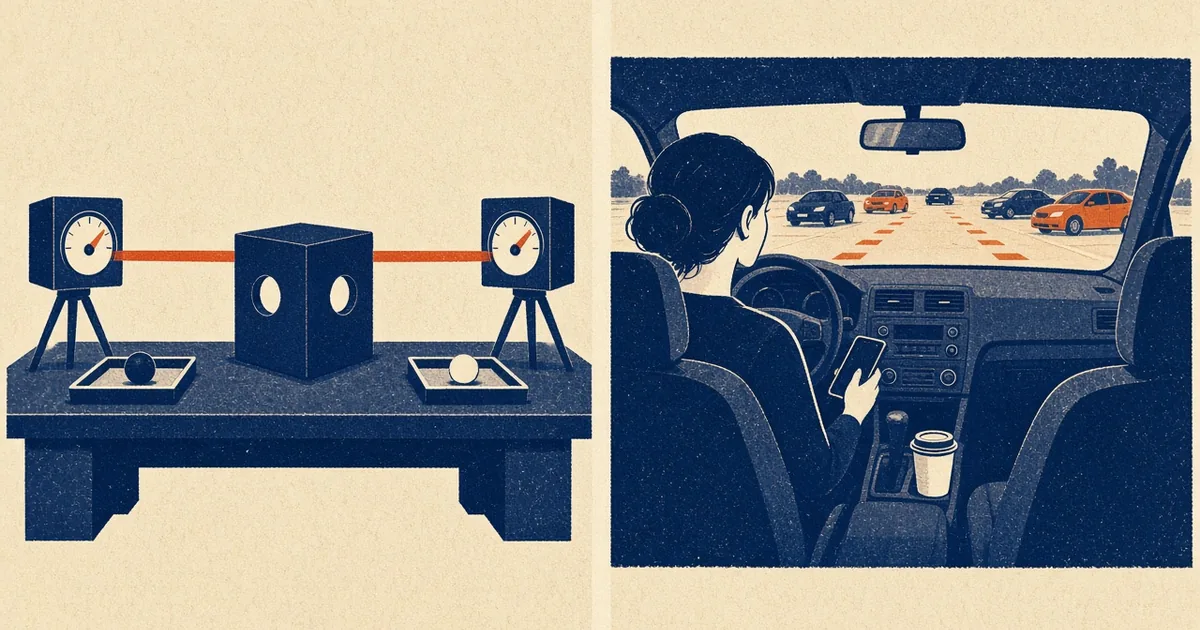
Say a woman named Dana wakes up thinking about a friend she has not talked to in six years. She does not know why. They worked at the same restaurant once, and then life moved them in different directions.
On the drive to work, a song comes on the radio that the two of them used to play during closing shifts. That afternoon her phone buzzes. It is the friend. She is moving back to town and wants to know if Dana wants to get coffee.
Dana is not a superstitious person. But she sits in her car for a minute before she answers.
What just happened?
This is a made-up example. It is also a very common kind of experience. People have mornings like Dana’s, and when they try to explain them, two words come up a lot. One is “entanglement,” from quantum physics. The other is “synchronicity,” from the psychologist Carl Jung.
I am not a physicist and I am not a Jungian analyst. I wanted to write this because I kept seeing those two words used as if they meant the same thing, and they do not. I think a lot of the confusion comes from people borrowing physics words for experiences that physics was never trying to describe. This piece goes through where each idea came from, how each one changed over time, and what each one claims today. Then it comes back to Dana.
Direct Answer
Quantum entanglement is a physical relationship between particles. When two particles are entangled, measurements on them show correlations that stay linked even when the particles are far apart, and experiments since the 1970s have confirmed this.[1][2] Entanglement cannot be used to send a message faster than light.[3] Synchronicity is a term Carl Jung used for a meaningful coincidence: two events that feel connected in meaning even though nothing ordinary caused one to produce the other.[4] Entanglement is tested physics. Synchronicity is a way of interpreting experience, and no experiment has shown it to be a physical law.[12][13] Neither one explains why you thought of someone right before they called.
Where entanglement came from
In May 1935, Albert Einstein, Boris Podolsky, and Nathan Rosen published a paper in Physical Review asking whether quantum mechanics gave a complete description of reality.[8] People call it the EPR paper, after the three authors.
Their argument went like this. If two particles interact and then fly apart, quantum mechanics says you can measure one and immediately know something about the other, no matter how far away it is. Einstein did not think something happening here could instantly affect something over there. So he argued the theory had to be missing information. In his view, the particles must have been carrying hidden instructions the whole time.[8]
The same year, Erwin Schrödinger gave the relationship a name. He wrote that when two systems interact and then separate, they “can no longer be described in the same way as before,” and he said their quantum states “have become entangled.” He called this the characteristic trait of quantum mechanics.[9]
A few terms help here.
- A quantum system is a very small physical thing, like an electron or a particle of light (a photon), that follows the rules of quantum mechanics.
- A measurement is when you check one of its properties, like the direction of its spin.
- A correlation means two results tend to line up in a pattern more often than chance alone would give you.
- Local means a thing can only be affected by what is near it, and any influence has to travel no faster than light.
Einstein later described what bothered him as “spooky action at a distance.”[2] That phrase stuck, and it is still how a lot of people first hear about entanglement.
How entanglement was tested
For almost 30 years the EPR question looked like a matter of opinion.[8][10] Did the particles carry hidden instructions from the start, or did they not?
Nobody knew how to tell the difference with an experiment.
In 1964, the physicist John Stewart Bell found a way. He worked out an inequality, a mathematical limit on how strongly the measurement results could line up if the particles really were carrying hidden instructions and nothing traveled faster than light. Quantum mechanics predicted that certain experiments would go past that limit.[1][10]
The Nobel Prize committee explained it with an analogy that I found clear. Picture a machine that throws out two balls in opposite directions, one black and one white. When Bob catches a black ball, he knows Alice caught a white one. If there are hidden instructions, the balls were black and white the whole time. Quantum mechanics says the balls were gray until someone looked, and then one randomly turned white and the other black. Bell’s inequality is the test that tells those two pictures apart.[2]
Then people ran the test.
John Clauser’s experiments in the 1970s found results that broke Bell’s limit, which supported quantum mechanics. Alain Aspect then closed an important gap by switching the measurement settings after the particles had already left their source, so the settings at the start could not have shaped the results. Anton Zeilinger and his colleagues went on to use entangled states for quantum teleportation and other quantum information work. The three of them shared the 2022 Nobel Prize in Physics.[1]
Older tests still left room for objections, which physicists call loopholes. In 2015, a team at Delft University of Technology reported a test in Nature with entangled electrons 1.3 kilometers apart that was designed to close the main loopholes at once. They ran 245 trials and found results that broke Bell’s limit.[11]
What entanglement means today
Today, entanglement is a basic and well tested part of physics. It is also a tool. It is used in research on quantum computers, quantum networks, and encrypted communication.[1] But being real and useful does not make it a theory about people.
There are also some things entanglement does not do.
It does not let anyone send a message faster than light. When Alice measures her particle, she gets a random result. She cannot choose which result she gets, so she cannot use it to send Bob anything. The correlation only shows up later, when the two of them compare notes through ordinary means like a phone call. That means the phone call, or some other normal signal, does all the real work of getting information from one place to the other. Physicists describe this by saying quantum correlations cannot be used for faster-than-light signaling.[3]
It does not apply to people the way it applies to particles in a lab. The experiments that show entanglement work with very small systems under very controlled conditions.[11] There is no experiment showing that two people, or two minds, are entangled in the physics sense. So I would be careful with anyone who uses entanglement to explain a relationship, a feeling, or a hunch.
And it does not prove that “everything is one” in a spiritual sense. It shows that the quantum states of particles that interacted can stay linked in a way older physics did not expect.[9] What a person believes about God, fate, or connection is a separate question, and physics does not settle it either way.
Where synchronicity came from
Carl Jung was a Swiss psychiatrist who founded analytical psychology. He was interested in coincidences for most of his career. His publisher says he talked about these ideas with Albert Einstein before World War I, and that he first used the word “synchronicity” in a 1930 lecture about the I Ching, the ancient Chinese text people consult by tossing coins or counting stalks.[4]
He gave his full statement of the idea in a 1952 essay called Synchronicity: An Acausal Connecting Principle.[4] Two terms from that title need a plain definition.
- Causal means one thing makes another thing happen. You flip the switch, and the light comes on.
- Acausal means two things are connected in some way, but neither one caused the other.
Jung’s claim was that some coincidences are meaningful even though there is no cause linking them. In the essay he gives an example from his own practice. A patient was telling him about a dream in which she was given a golden scarab. While she was talking, he heard tapping at the window. He opened it and caught a beetle, a rose chafer, which he described as the closest thing to a golden scarab found where he lived.[4]
Jung did not say the beetle came because of the dream. He wrote that the timing and the meaning lined up in a way that reached the patient, and that her treatment, which had been stuck, finally started to move after it.[4]
How synchronicity spread
Jung worked out a lot of this idea in letters with the physicist Wolfgang Pauli, who had won a Nobel Prize. Their letters run from 1932 to 1958 and were later published as a book.[5] Jung’s synchronicity essay first came out in a 1952 volume the two of them published together, which appeared in English as The Interpretation of Nature and the Psyche.[6]
So why do people mix the two up?
That history explains part of the confusion. Pauli was one of the people who built quantum mechanics. So people sometimes assume synchronicity has physics behind it.
It does not. The letters are a long conversation about mind and matter. They are not an experiment, and they do not show that quantum effects cause coincidences between people.[5]
After Jung, the idea moved well past psychology. The writer Arthur Koestler built a popular book around coincidence and parapsychology in 1972.[7] Today you can find books and videos that put the word “quantum” in front of ideas like the law of attraction to make them sound scientific. That is where most of the mixing of entanglement and synchronicity happens. The result is that two very different ideas now get sold as if they were one.
What synchronicity means today
Synchronicity is not a physical law. No experiment has shown an acausal force that links events together. The people who study coincidences scientifically, mostly statisticians and psychologists, explain most of them with probability and with the way people notice patterns.[12][13]
The statisticians Persi Diaconis and Frederick Mosteller studied coincidences in a 1989 paper in the Journal of the American Statistical Association. One of their main points was what they called the law of truly large numbers: with a large enough sample, any outrageous thing is likely to happen.[12] There are billions of people having thousands of thoughts a day. Some of those thoughts will line up with phone calls, songs, and news just by chance.
They also used the birthday problem. In a group of only 23 people, there is better than an even chance that two of them share a birthday.[12] Most people guess the number would need to be much higher. Coincidences feel rare because we judge them by our gut, and our gut is not good at probability. That means a strange coincidence is not, by itself, evidence of anything beyond the coincidence.
There is also a name for seeing patterns that are not really there: apophenia. And people remember the hits and forget the misses. Dana will remember the morning she thought of her friend and the friend called. She will not remember the hundreds of mornings she thought of someone and nobody called. The psychologists Mark Johansen and Magda Osman argue that noticing coincidences is a basic result of rational thinking, not a mistake in it.[13]
That does not mean every synchronicity experience is worthless.
Some therapists still find the idea useful. In a 2016 survey of 226 counsellors, psychologists, and psychotherapists in the United Kingdom, 44 percent said they had experienced synchronicity in the therapy setting, and 67 percent felt those experiences could be useful for therapy.[14] In that setting, the question is not whether the universe sent a message. The question is what the person noticed and what it brought up for them.
So here is a fair way to hold it. Synchronicity is not proof of fate. It is a name for a kind of experience people really have, and a way of asking what that experience means to them.
Back to Dana
Now go back to Dana sitting in her car.
Entanglement does not explain her morning. She and her friend are not entangled particles. Even if they were, entanglement cannot carry a message, and a text asking about coffee is a message.[3]
Probability explains a lot of it.
Dana and her friend shared a past, a restaurant, and a song. It is not strange that the friend would think of Dana when she was planning a move back to town. It is not strange that a song from that time would play on a local station. And it is not strange that Dana would think of an old friend on a random morning, since people do that all the time without anything happening after.[12]
What is left is the part only Dana can answer. Maybe the morning reminds her that she misses having that friend around. Maybe it pushes her to say yes to coffee when she would normally say she is too busy. If she wants to call that synchronicity, she is using Jung’s word the way he meant it: for a coincidence that means something to the person living it, not for a force that made it happen.[4] In the end, that part is hers to decide, and nobody else’s.
For me, what helps is knowing that Dana does not have to choose between being a skeptic and taking the morning seriously. The physics is about particles. The meaning is about Dana.
She can go get the coffee without needing either one to be more than it is.
Frequently Asked Questions
What is quantum entanglement in simple terms?
Quantum entanglement is when two particles that have interacted stay linked, so measurements on them show correlations even after they are far apart. Schrödinger named it in 1935, and experiments that break Bell’s inequality have confirmed it.[1][9]
Can entanglement send information faster than light?
No. Each measurement result on its own is random, and the person measuring cannot choose it, so it cannot carry a message. The correlation only shows up when the results are compared through ordinary communication.[3]
What did Carl Jung mean by synchronicity?
Jung used synchronicity to mean a meaningful coincidence: two events that line up in meaning even though neither one caused the other. His main essay on it, Synchronicity: An Acausal Connecting Principle, came out in 1952.[4]
Is synchronicity scientifically proven?
No. No experiment has shown an acausal force that links events. Statisticians and psychologists who study coincidences, including Diaconis and Mosteller, explain most of them with probability and with the way people notice patterns.[12][13]
Does quantum entanglement explain synchronicity?
No. Jung and the physicist Wolfgang Pauli discussed quantum ideas while Jung was developing synchronicity, but that was a collaboration of ideas, not an experiment. There is no evidence that entanglement causes meaningful coincidences between people.[5][11]
Why do coincidences happen so often?
Because there are so many chances for them. Diaconis and Mosteller called this the law of truly large numbers: with a large enough sample, any outrageous thing is likely to happen. The birthday problem is one example, since 23 people give better than even odds that two share a birthday.[12]
References
- The Royal Swedish Academy of Sciences. The Nobel Prize in Physics 2022: Press release. October 4, 2022. Prize to Alain Aspect, John Clauser, and Anton Zeilinger “for experiments with entangled photons, establishing the violation of Bell inequalities and pioneering quantum information science”; Bell’s inequality in the 1960s; Clauser’s experiment supported quantum mechanics; Aspect switched the settings after the pair left the source; applications in quantum computers, quantum networks, and encrypted communication.
- The Royal Swedish Academy of Sciences. The Nobel Prize in Physics 2022: Popular information. 2022. Einstein’s “spooky action at a distance”; Schrödinger called entanglement the most important trait of quantum mechanics; analogy of black and white balls that are gray until observed; quantum teleportation first done in 1997 by Zeilinger and colleagues.
- Myrvold W, Genovese M, Shimony A. Bell’s Theorem. Stanford Encyclopedia of Philosophy. Quantum correlations cannot be exploited for superluminal (faster-than-light) signalling; no-signalling and quantum key distribution.
- Jung CG. Synchronicity: An Acausal Connecting Principle. Translated by R. F. C. Hull. Princeton University Press, Bollingen Series (essay first published 1952). Publisher description: discussed coincidences with Einstein before World War I; first used “synchronicity” in a 1930 lecture on the I Ching; long correspondence with Wolfgang Pauli. Scarab and rose chafer account (1973 Princeton edition, p. 27).
- Meier CA, ed. Atom and Archetype: The Pauli/Jung Letters, 1932-1958. Translated by David Roscoe. Princeton University Press; 2001. Review: Physics Today 55(9):62-63, doi:10.1063/1.1522220.
- Jung CG, Pauli W. The Interpretation of Nature and the Psyche (German original Naturerklärung und Psyche, 1952). Pantheon Books, Bollingen Series LI; 1955. Contains Jung’s “Synchronicity: An Acausal Connecting Principle” and Pauli’s essay on Kepler.
- Koestler A. The Roots of Coincidence. Hutchinson; 1972. Review: Journal of the British Society for Phenomenology 4:188-189, doi:10.1080/00071773.1973.11006323.
- Fine A. The Einstein-Podolsky-Rosen Argument in Quantum Theory. Stanford Encyclopedia of Philosophy. May 15, 1935 Physical Review paper “Can Quantum-Mechanical Description of Physical Reality Be Considered Complete?” by Einstein, Podolsky, and Rosen; intuitive local action versus completeness of the quantum description.
- Bub J. Quantum Entanglement and Information. Stanford Encyclopedia of Philosophy. Schrödinger (1935, p. 555) coined “entanglement”: systems that interact and separate “can no longer be described in the same way as before”; “the characteristic trait of quantum mechanics”; the two quantum states “have become entangled.”
- Bell JS. On the Einstein Podolsky Rosen Paradox. Physics Physique Fizika. 1964;1(3):195-200. doi:10.1103/PhysicsPhysiqueFizika.1.195.
- Hensen B, Bernien H, Dréau AE, et al. Loophole-free Bell inequality violation using electron spins separated by 1.3 kilometres. Nature. 2015;526:682-686. Entanglement between distant electron spins; 245 trials; CHSH-Bell inequality violated (S = 2.42 ± 0.20); closes the detection and locality loopholes together.
- Diaconis P, Mosteller F. Methods for Studying Coincidences. Journal of the American Statistical Association. 1989;84(408):853-861. Law of truly large numbers (“with a large enough sample, any outrageous thing is likely to happen”); birthday problem (23 people give better than even odds of a shared birthday); sources of coincidences.
- Johansen MK, Osman M. Coincidences: A fundamental consequence of rational cognition. New Ideas in Psychology. 2015;39:34-44.
- Roxburgh EC, Ridgway S, Roe CA. Synchronicity in the therapeutic setting: A survey of practitioners. Counselling and Psychotherapy Research. 2016;16(1):44-53. Online survey of UK counsellors, psychologists, and psychotherapists; 226 respondents; 44 percent reported experiencing synchronicity in the therapeutic setting; 67 percent felt synchronicity experiences could be useful for therapy.